
Resource
Why AI Humanizers Often Fail to Bypass Detectors — And What the 2026 Tests Show
Why word-swapping is not enough — September 2026 ZeroGPT scores on 5 Thorough rewrites, Turnitin purple bypasser detection, and why no tool can guarantee a pass.
Published June 15, 2026 · Updated September 18, 2026 · Naturalmelo Team
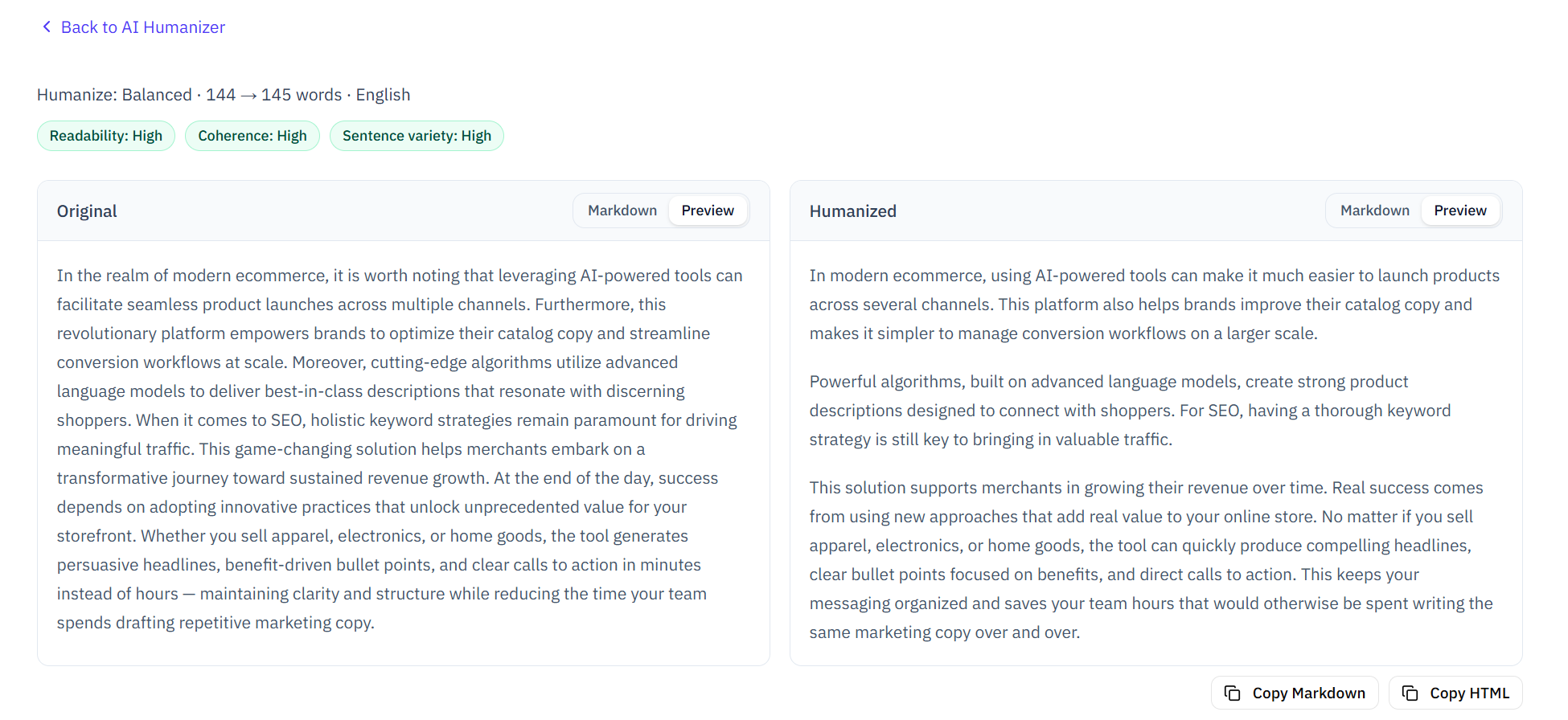
Side-by-side original vs humanized output comparison
September 2026 Recheck: Bypass Is Uneven
If humanizers “just worked,” every Thorough rewrite would drop detector scores. They do not. On 18 September 2026 we ran the same five GPT-style drafts (college essay, business email, blog intro, discussion post, marketing landing) at Thorough intensity using Naturalmelo’s public rewrite rules, then scored them on ZeroGPT’s public detector. GPTZero’s guest scan now returns “Require login or API key,” so we did not record GPTZero percentages. This is not Turnitin.
ZeroGPT AI% before → after Thorough:
Four drafts moved. The essay did not. [HumanizerBench](https://humanizerbench.com/leaderboard/)’s September 2026 cycle ranked WriteHuman #1 at 78.29 overall / 90.1% bypass across five detectors — Naturalmelo is not on that paid board. A free detect → rewrite → re-check loop you can repeat is not the same as a leaderboard average, and neither is a Turnitin result.
- College essay: 100% → 100% (still labeled AI/GPT generated)
- Business email: 100% → 64.7%
- Blog introduction: 100% → 5.9% (labeled human written)
- Academic discussion: 100% → 14.7% (labeled human written)
- Marketing landing: 100% → 51.8%
- Average: 100% → 47.4%
Why Word-Swapping Doesn't Work
Most AI humanizers work by replacing words with synonyms and shuffling sentence structures. This approach fails for a simple reason: AI detectors don't look at individual words — they look at statistical patterns across entire passages. Changing "utilize" to "use" and "additionally" to "also" doesn't change the underlying probability distribution that detectors measure.
Perplexity-based detectors like GPTZero measure how "surprised" a language model would be by each word. Synonym substitution does almost nothing to change perplexity because the replacements are themselves highly probable — that's why the thesaurus suggested them. To genuinely change the statistical profile, you need to change the structure of your thinking, not just the words.
Adversarial Detection: How Tools Are Fighting Back
Turnitin's August 2025 update introduced bypasser detection — a model specifically trained to identify text that has been run through humanizers. Instead of detecting AI output directly, it detects the fingerprint of humanization: awkward synonym choices, unnatural sentence restructuring, and the statistical signature of automated rewriting algorithms.
This is adversarial detection: detection designed to catch attempts to evade detection. Independent tests show that humanized text flagged by bypasser detection often triggers more scrutiny than the original AI text. It creates a cat-and-mouse dynamic where yesterday's humanization technique becomes tomorrow's detection target. The humanizer tools update to evade the new detection; the detection models update to catch the new evasion. Students caught in the middle get flagged not for using AI but for trying to hide it.
What Actually Works: Human-in-the-Loop
The most reliable approach is not better humanization software — it's human judgment. Write your draft yourself (with or without AI assistance), run it through a detector to identify templated phrasing, and then manually revise the flagged sections in your own voice. The detector becomes an editor, not a judge.
This human-in-the-loop approach works because human revision changes the underlying structure of the writing — not just the surface words. When you rewrite a sentence because you understand what it's trying to say, you naturally produce the kind of variation, unpredictability, and personal voice that detectors recognize as human. No automated tool can replicate that.
The Quality Trade-Off Most Humanizers Don't Mention
Aggressive humanization degrades text quality. In independent testing, thorough humanization settings reduced AI detection by 70-85% — but readability scores dropped, coherence weakened in longer passages, and some sentences became unnatural. The output passed detection but read worse than the original.
This trade-off is rarely discussed by humanizer companies, but it's the central challenge of the technology: the features that make text "human-like" to a detector (variation, unpredictability, idiosyncrasy) are not the same features that make text good. Clear, well-structured, grammatically correct writing can trigger detectors precisely because it's clear, well-structured, and grammatically correct.
Quick Tips
Revise flagged sentences manually. The best humanizer is you. When a detector flags a sentence, rewrite it yourself based on your understanding. Manual revision produces authentic variation that automated tools cannot.
Do not chase zero percent. A 0% AI score on a 1000-word essay is suspicious in its own right. Aim for reducing templated phrasing, not for a perfect score. Your goal is authentic writing, not statistical evasion.
Be aware of bypasser detection. Turnitin now specifically detects humanized text (purple highlights). Running AI text through a humanizer doesn't guarantee passing — it may just change the type of flag.
Self-check at every stage. Use a detector throughout your writing process, not just at the end. Check after drafting, after humanizing, and after manual editing. Each pass shows you what still needs attention.
Frequently Asked Questions
Common questions about AI humanizer limitations.
Q: Why don't AI humanizers work as advertised?
Humanizers change surface-level words and sentence structures, but detectors measure deeper statistical patterns (perplexity, burstiness) that word-swapping doesn't change. Additionally, modern detectors include bypasser detection specifically trained to catch humanized text.
Q: What is adversarial AI detection?
Adversarial detection targets attempts to evade detection. Turnitin's bypasser detection (Aug 2025) is trained on output from humanizer tools — it doesn't just look for AI patterns, it looks for the characteristic fingerprint of automated rewriting. It's detection designed to catch evasion of detection.
Q: Is manual rewriting better than using a humanizer?
Yes. When you rewrite a sentence because you understand its meaning, you naturally produce the variation in word choice, sentence structure, and rhythm that detectors recognize as human. Manual revision also improves your understanding of the material — automated humanization doesn't.
Q: Can a humanizer make my text completely undetectable?
No. Detection and humanization are locked in an ongoing arms race. Today's evasion technique can become tomorrow's detection target. The most sustainable approach is writing with authentic voice and using detection as editing feedback, not trying to achieve a perfect score.
See what a hybrid detector catches
Run your text through Naturalmelo's free AI checker to see which sentences sound templated — then revise them in your own voice.
Run AI writing check