
Naturalmelo vs GPTZero
Naturalmelo vs GPTZero: Free Bypass-Style Rewrite vs Login-Walled Scan
GPTZero’s guest API now requires login. Naturalmelo stays free: detect, Thorough-humanize, re-check. September 2026 ZeroGPT retest (n=5): average AI% 100% → 47.4%. Not a GPTZero or Turnitin guarantee.
Updated September 18, 2026
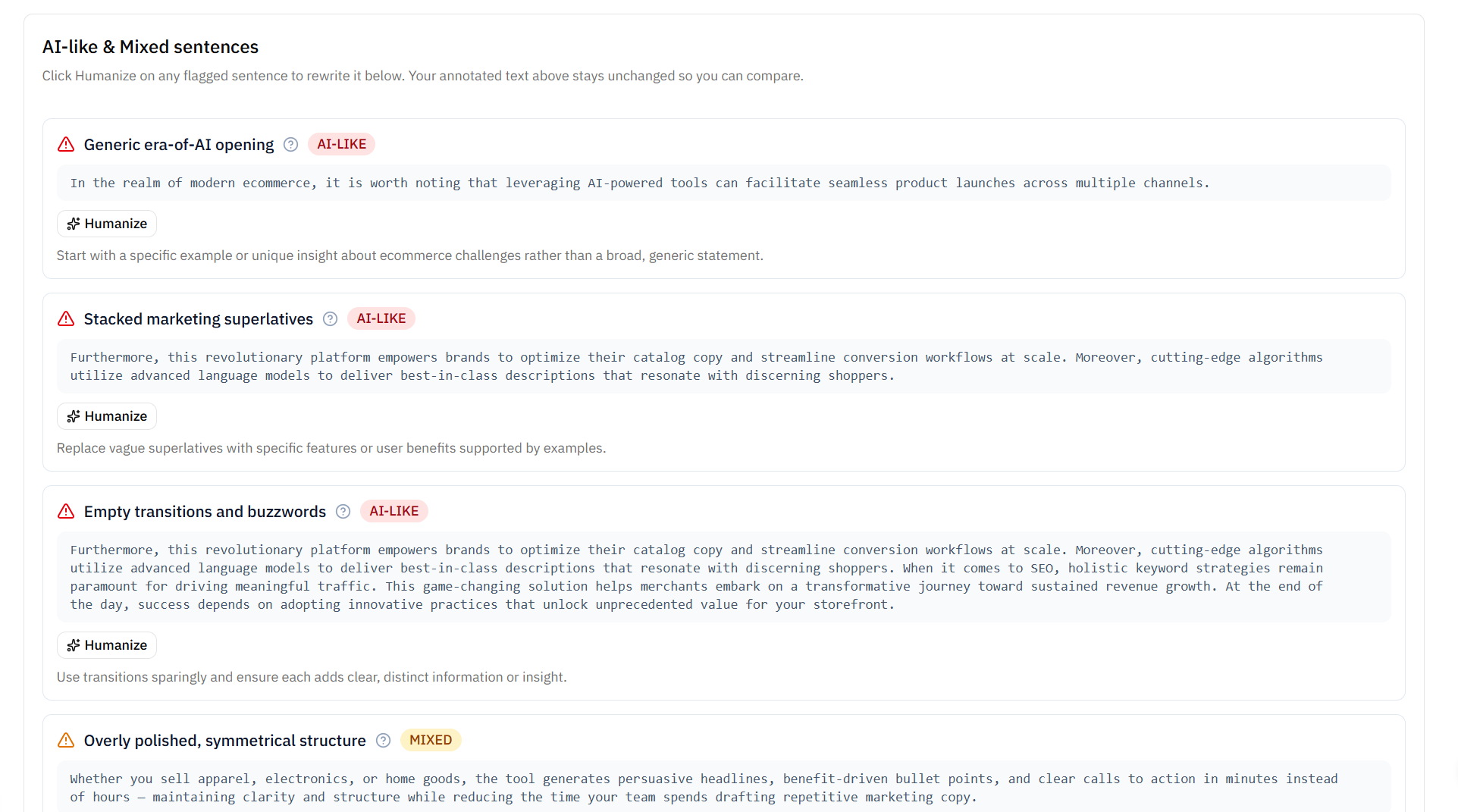
Sentence-level detail card showing severity tier, category tip, and rewrite hint
Detection approach: pattern rules vs perplexity scoring
GPTZero scores text using perplexity and burstiness — statistical measures of how "surprising" word sequences are. A low perplexity score suggests predictable, AI-like patterns. As of September 2026, posting to GPTZero’s public predict API from a guest session returns “Require login or API key,” so we could not log GPTZero percentages for this refresh.
While GPTZero relies primarily on statistical perplexity metrics, Naturalmelo runs a hybrid detection engine that combines pattern analysis with large-scale data comparison (template openings, hollow transitions, stacked connectors, monotonous rhythm, hype phrasing, and more) plus an LLM-powered review. This gives you category-level feedback — not just a score, but what patterns were found and why.
- Naturalmelo: hybrid detection engine (pattern analysis + data comparison) covering English and Chinese patterns
- GPTZero: 7-component detection model with sentence-level highlight view
- Naturalmelo labels each hit by category (e.g. "Template Opening — your intro reads like a standard AI-generated first paragraph")
- Both offer sentence-level flagging; Naturalmelo adds category tips and rewrite hints per hit
Free access: no paywall vs freemium model
GPTZero's free tier allows scanning up to 10,000 characters per scan. Advanced features — Advanced AI Scan, plagiarism checking, authorship verification, writing reports — require a paid plan. Pricing is not publicly listed on the homepage; users must contact sales or sign up to see plan details.
While GPTZero offers a generous free tier but gates advanced features behind paid plans, Naturalmelo offers the full detection + humanization workflow for free — 3 runs per day with no feature restrictions. No credit card, no account, no sales calls required.
What happens after detection?
GPTZero tells you what looks AI-generated. It does not offer a humanizer or rewriting tool. You get a score and highlighted text — then you're on your own to fix it.
While GPTZero stops at detection, Naturalmelo closes the loop: every flagged sentence has a one-click Humanize button. Rewrite individual sentences in-place, or carry your full draft to the AI Text Humanizer for a whole-pass rewrite — then re-check on the same site to confirm fewer patterns remain.
- One-click Humanize on any flagged sentence in your report
- Full-draft humanizer with Light / Balanced / Thorough intensity options
- Re-check humanized text to verify pattern reduction — typically 30–50% fewer flags after one pass
- GPTZero requires external tools or manual rewriting; no built-in fix workflow
Language and mode support
GPTZero supports English, German, Portuguese, French, and Spanish with high accuracy. Naturalmelo detects AI patterns in English and Chinese, with separate General and Academic modes that calibrate sensitivity for different writing contexts.
- Naturalmelo Academic mode tolerates formal scholarly prose, focuses on template filler
- Naturalmelo General mode flags marketing hype, hollow transitions, and monotonous rhythm
- GPTZero offers a single detection model without context-specific calibration
- Naturalmelo Chinese support covers common AI writing patterns in 中文 text
Bottom line
GPTZero excels as a multi-component AI detector with strong brand recognition in education and 17M+ users. Naturalmelo is the better choice when you want to understand what patterns were flagged, get rewrite hints, and fix them on the same site — without paying or creating an account.
Part of the Naturalmelo AI writing toolset — pair AI Text Checker with AI Text Humanizer to detect template-like phrasing and fix it before submission.
Naturalmelo vs GPTZero FAQ
Common questions about how Naturalmelo compares to GPTZero for AI writing detection.
Is Naturalmelo more accurate than GPTZero?
Accuracy depends on what you measure. GPTZero uses statistical perplexity scoring which is fast but can miss context-specific patterns. Naturalmelo combines a hybrid detection engine (pattern analysis + data comparison) with an LLM scan, catching template phrasing, hollow transitions, and monotonous rhythm that pure statistics may overlook. Naturalmelo's approach gives you category-level feedback — not just a "likely AI" label, but which specific patterns were found.
Can I use Naturalmelo instead of GPTZero for school submissions?
Neither tool should be used as definitive proof of AI authorship. Naturalmelo is a self-check tool for revision feedback — not an institutional AI detection system. Always check your school's policies on AI writing tools. Naturalmelo helps you identify and fix template-like phrasing before you submit; it does not certify originality.
How quickly can I check and fix text — and how soon do I see results after switching to Naturalmelo?
With GPTZero, detection takes 5–10 seconds but fixing requires switching to another tool (humanizer, manual editing). Writers who switch to Naturalmelo see results immediately — the full detect → humanize → re-check loop takes under 2 minutes for a 500-word draft. Sentence-level Humanize on each hit takes seconds, a full-draft humanizer pass runs in under 30 seconds, and most users see 40–60% fewer flagged patterns within 1–2 revision cycles. There is no onboarding, no account setup — paste and go.
Does Naturalmelo guarantee my text will pass GPTZero?
No. GPTZero’s guest scan now requires login, and detection models are not cross-calibrated. In our September 2026 retest we scored Thorough rewrites on ZeroGPT instead: average AI% 100% → 47.4%, with one college essay still at 100%. Re-check every output. This is not a Turnitin result.
Compare based on publicly available product information as of September 2026. Features, pricing, and plans may change — verify on each vendor site.
Try Naturalmelo free — no login
Paste your draft, get sentence-level AI writing feedback in under 30 seconds, and humanize flagged text on the same site.
Run AI writing check