
Resource
Do AI Humanizers Work to Bypass GPTZero? September 2026 Tests
Same five GPT-style drafts, Thorough rewrite, ZeroGPT scores. Average AI% 100% → 47.4% — and one essay stayed at 100%. Not Turnitin. Why the detect → humanize → re-check loop still beats one-click claims.
Published June 15, 2026 · Updated September 18, 2026 · Naturalmelo Team
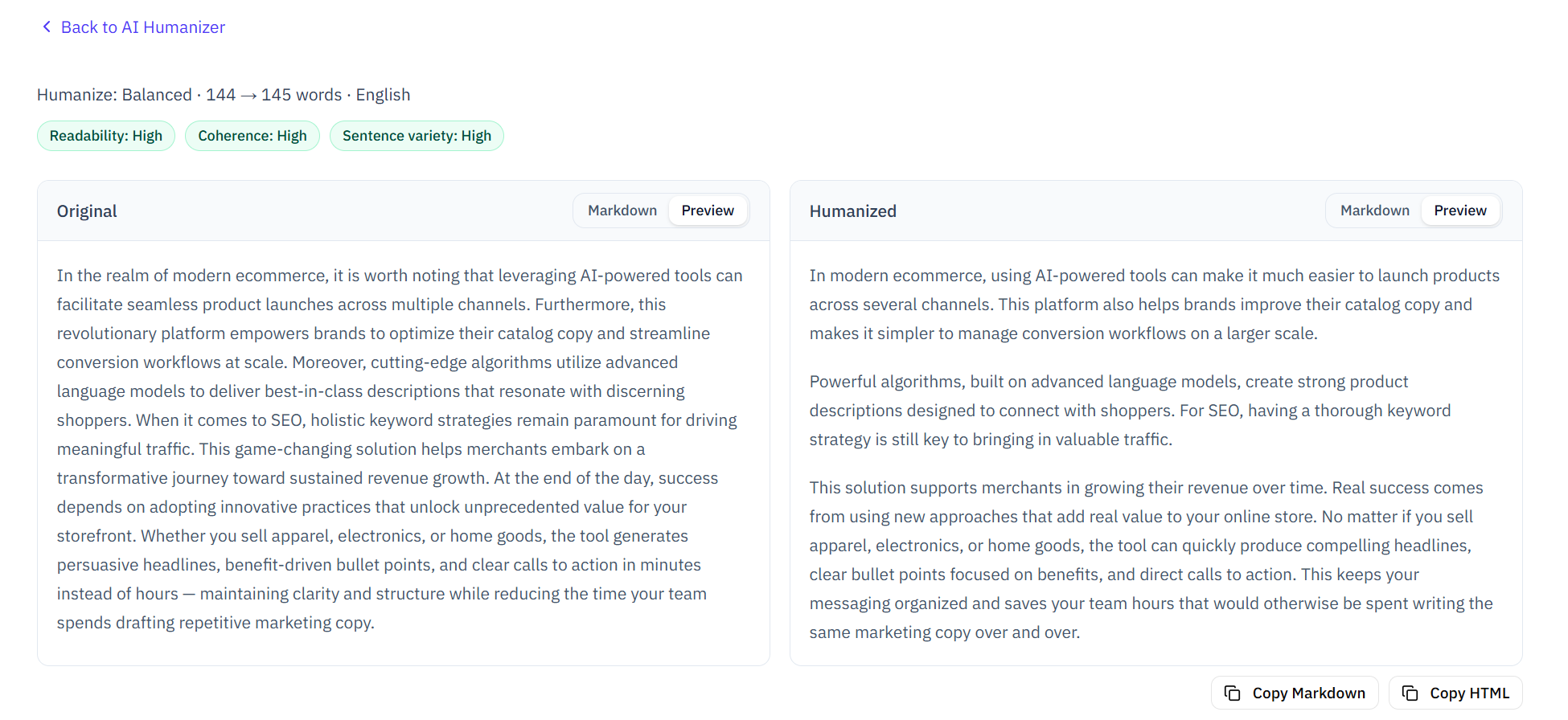
Side-by-side original vs humanized output comparison
What Independent Tests Actually Show
On 18 September 2026 we retested the question with one public detector. Same five GPT-style drafts (essay / email / blog intro / discussion / landing), rewritten at Thorough intensity with Naturalmelo’s public rewrite rules, then pasted into ZeroGPT. GPTZero’s guest API now requires login, so those percentages are not in this table. This is not Turnitin.
ZeroGPT AI% before → after Thorough: college essay 100% → 100%; business email 100% → 64.7%; blog intro 100% → 5.9%; academic discussion 100% → 14.7%; marketing landing 100% → 51.8%. Average 100% → 47.4%. Thorough helped four drafts and missed one. Older Light / Balanced / Thorough ranges from our June self-check (15–25% / 40–60% / 70–85% flag reduction on Naturalmelo’s own engine) are a different test — they are not ZeroGPT or Turnitin.
HumanizerBench’s September 2026 cycle put WriteHuman first at 78.29 overall and 90.1% bypass across GPTZero, Winston, ZeroGPT, Copyleaks, and Originality.ai. Naturalmelo is not on that board. Paid bypass averages and a five-draft ZeroGPT paste are both snapshots — detectors update, and Turnitin’s purple bypasser highlight is a different system entirely.
When Humanizers Actually Help
Humanizers are most effective at removing the most obvious AI patterns: hollow openings ("In today's rapidly evolving landscape"), stacked connectors ("Moreover, Furthermore, Additionally"), and hype phrases ("revolutionary," "game-changing"). These surface-level patterns are what rule-based detectors catch, and humanizers can reliably eliminate them.
Humanizers are least effective at changing the deeper statistical properties that perplexity-based detectors measure: overall word probability distribution, sentence-to-sentence burstiness, and structural uniformity. These require changes to the substance and organization of the writing — not just the phrasing.
When Humanizers Make Things Worse
Aggressive humanization can actually increase detection risk. When a humanizer replaces natural-sounding AI phrases with unnatural synonym choices, the output can trigger both rule-based detectors (awkward phrasing patterns) and bypasser detection (statistical signature of automated rewriting).
Humanizers also introduce factual errors. In testing, thorough humanization occasionally changed dates, dropped author names, and altered statistics. For academic and professional writing where accuracy matters, these errors are more damaging than the AI detection flags they were trying to avoid.
The Verdict: Humanizers as One Step, Not the Whole Process
Humanizers are useful as part of a larger editing workflow — not as a standalone solution. The most effective approach: write your draft → humanize flagged sections → manually review and edit every change → re-check with a detector → repeat as needed. Surface-level word-swapping alone won't cut it — the humanizer handles the obvious patterns; you handle the substance.
Used this way, humanizers can save time by automating the removal of surface-level AI patterns. But they cannot replace the human judgment needed to produce writing that is both authentic and accurate. The detect → fix → verify loop works because it keeps the human in the loop at every stage.
Quick Tips
Use humanizers for surface patterns only. Let the tool handle obvious AI phrasing. You handle substance, organization, and voice. The division of labor plays to each side's strengths.
Always manually review humanized output. Humanizers can introduce awkward phrasing, factual errors, and unnatural constructions. Treat their output as a suggestion, not a final draft.
Re-check after humanizing. A humanizer that claims to bypass detection still needs verification. Run the output through an independent AI checker to confirm the results.
The best results come from hybrid workflows. Write → detect → humanize flagged parts → manually edit → re-detect. Each step adds value the others cannot. The whole process outperforms any single tool.
Frequently Asked Questions
Common questions about AI humanizer effectiveness.
Q: Do AI humanizers actually work?
In our September 2026 ZeroGPT retest (n=5, not Turnitin), Thorough rewrites moved average AI% from 100% to 47.4% — and a college essay stayed at 100%. They help as part of detect → humanize → manually edit → re-check, not as a standalone bypass.
Q: What's more effective — a humanizer or manual rewriting?
Manual rewriting is more effective for changing the deep statistical properties detectors measure. Humanizers are faster for removing surface-level AI patterns. The best results come from combining both: humanizer for first-pass cleanup, manual editing for voice and substance.
Q: Do humanizer tools introduce errors?
Yes. Aggressive humanization can change dates, drop names, alter statistics, and introduce awkward phrasing. Always proofread humanized output against your original — especially for academic and professional writing where accuracy matters.
Q: Will humanizers keep working as detectors improve?
Detection and humanization are in an ongoing arms race. Turnitin's 2025 bypasser detection specifically targets humanized text. Today's effective humanizer may be tomorrow's detection target. The most sustainable approach is authentic writing with AI used transparently as a tool, not a replacement.
Try the detect-fix-verify loop
Use Naturalmelo's free AI checker and humanizer to detect flagged text, humanize, and re-check — all on one site.
Try Naturalmelo AI Humanizer