
Resource
College Admissions and AI Detection: How Universities Handle Application Essays in 2026
Which colleges check application essays for AI, how detection works in admissions, and how to keep your authentic voice in the age of AI-written personal statements.
Published June 15, 2026 · Naturalmelo Team
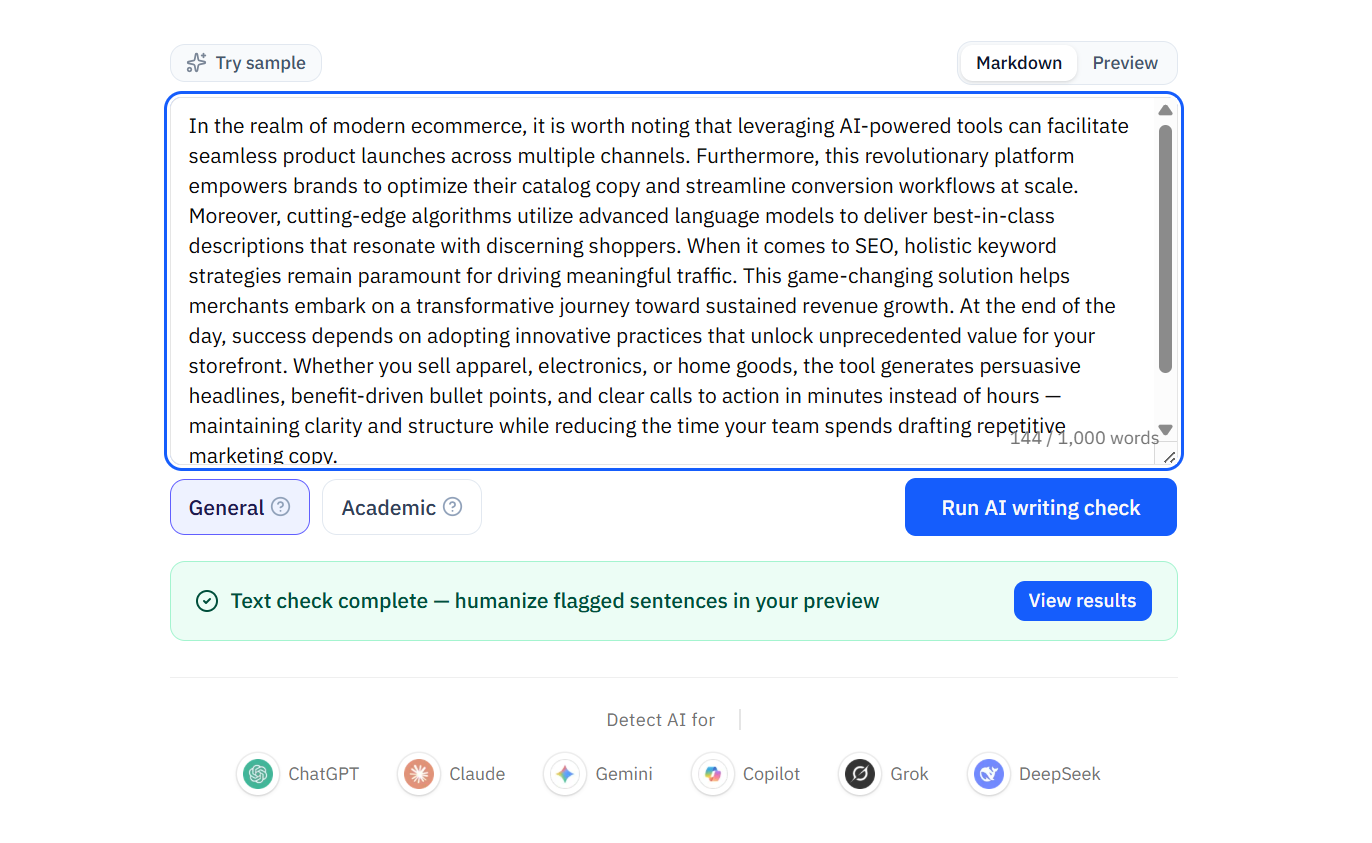
Sentence-level AI detection with pattern-based highlighting
Do Colleges Actually Check for AI in Application Essays?
The short answer: some do, most don't, but all admissions officers are paying attention. A 2025 NACAC survey found that 23% of colleges have run application essays through AI detection — up from 8% in 2024. Large public universities with high application volumes are the most likely to use automated screening. Small liberal arts colleges with holistic, multi-reader review processes are the least likely.
But the more meaningful statistic is this: 67% of admissions officers reported "suspecting AI use" in at least one essay — not because of software, but because the writing felt generic. An essay that could have been written by anyone about anything is its own red flag, with or without detection software.
How AI Detection Works in Admissions
Colleges that check for AI typically use institutional licenses for tools like Turnitin or GPTZero, integrated into their application management systems. But the process is not automatic rejection — a flagged essay gets a closer read, not a denial letter. Admissions officers compare the essay against the rest of the application: do the grades match the writing quality? Do the teacher recommendations describe a writer at this level?
The most important fact for applicants: no college publicly states that it auto-rejects based on AI detection. The more common outcome is that the essay is mentally discounted — the officer sets it aside and evaluates the rest of the file. In a competitive cycle, losing the essay means losing your primary voice in the application.
What Admissions Officers Notice More Than Detectors
Experienced readers spot AI-generated essays because they lack specificity. Real essays contain specific moments, specific people, specific sensory details. AI essays contain generic epiphanies and tidy resolutions. An essay about "learning the value of perseverance through overcoming a challenge" could describe anyone. An essay about "the summer you rebuilt a 1987 Honda with your grandfather, and the way he whistled through his teeth when a bolt was stuck" describes only you.
Voice consistency across the application is another signal. If the personal essay sounds like a graduate thesis but the activities section reads like text messages, a human reader notices. The best defense against AI suspicion is authenticity — not because it evades detection, but because detection becomes irrelevant when the writing is unmistakably personal.
How to Write Essays That Stand on Their Own
Start with a specific memory, not a general theme. The essay that begins "The afternoon my grandmother handed me a wooden spoon and told me to stir" is immediately real. The essay that begins "Leadership is an essential quality in today's world" is immediately AI territory. Specific details are your superpower.
Write your first draft without AI — no ChatGPT, no suggestions, just you and a blank page. The first draft can be messy. It should be messy. Polish comes later; voice comes first. After you have a real draft in your real voice, then you can use tools for feedback: "Does this paragraph make sense?" "Where do I lose the thread?" But the foundation has to be yours.
When AI Use Is Appropriate — and When It Crosses the Line
Brainstorming topics with AI is fine — asking "what are some angles on a volunteering experience?" helps you explore possibilities. Getting feedback on clarity is fine — "does this paragraph flow?" is a reasonable question. But generating paragraphs, asking AI to "improve" your writing to sound smarter, or using a humanizer to evade detection crosses an ethical line that also happens to be self-defeating: the result is an essay that sounds like nobody.
The application is a representation of you. If you would not feel comfortable telling an admissions officer "I used AI for this," do not use AI for that part. The test is simple because the stakes are simple: they are deciding whether to invite you into their community. They want to know who you are. AI cannot answer that question.
Quick Tips
Start with a specific memory, not a theme. The best essays begin with a moment: a conversation, a failure, a discovery. General themes produce generic essays. Specific moments produce unmistakable ones.
Write your first draft entirely without AI. Get your real thoughts and voice onto the page before touching any tool. AI can help you edit later — it cannot help you be yourself.
Check voice consistency across your application. Your personal essay, activities descriptions, and supplemental responses should all sound like the same person. Read them side by side and revise for consistency.
Self-check before submitting. Run your essays through an AI checker to see if any passages might trigger flags. Then revise in your voice — not to evade detection, but to make sure your writing sounds like you.
Frequently Asked Questions
Common questions about AI detection in college admissions.
Q: Do colleges run AI detection on application essays?
About 23% of colleges reported doing so in 2025, up from 8% in 2024. Large public universities are the most likely. Most that do use it treat it as a flag for closer reading, not an automatic filter. No college publicly rejects applicants based solely on an AI detection score.
Q: Can admissions officers tell if my essay is AI-generated without software?
Yes — and this is the more important risk. Experienced readers recognize generic essays instantly: structurally perfect but emotionally flat, full of broad statements and tidy conclusions. An essay lacking specific personal details raises suspicion whether or not software confirms it.
Q: What happens if my essay gets flagged?
Most commonly, the essay is discounted — the officer evaluates the rest of your application without the essay's contribution. In competitive admissions, this effectively wastes your primary opportunity to differentiate yourself. Formal rejection solely for AI use is rare; wasted opportunity is common.
Q: Is it okay to use AI for brainstorming or editing my college essay?
Brainstorming topics and getting feedback on clarity are generally acceptable. Generating paragraphs, using AI to sound "more sophisticated," or running text through a humanizer crosses an ethical line. If you would not comfortably tell an admissions officer about your AI use, do not use AI for that purpose.
Self-check your essays before applying
Run your personal statements through Naturalmelo's free AI checker to see which passages might trigger detection — then revise in your authentic voice.
Run AI writing check