
Resource
Best AI Humanizer to Bypass Turnitin & GPTZero (2026 Tests)
September 2026 ZeroGPT retest on 5 Thorough drafts, HumanizerBench rankings (WriteHuman 78.29 / 90.1% bypass — Naturalmelo is not on that board), and how to choose a free detect → rewrite → re-check loop. Not a Turnitin guarantee.
Published July 29, 2026 · Updated September 18, 2026 · Naturalmelo Team
Side-by-side original vs humanized output with readability and quality signals
Why Comparing Humanizers Matters
The AI humanizer market in 2026 is crowded. A quick Google search returns dozens of tools promising to make AI text "undetectable" — but the gap between marketing claims and actual performance is vast. Some tools are sophisticated restructuring engines that rewrite at the paragraph level. Others are thin wrappers around a single API call that swap synonyms and call it humanization — which is why many humanizers fail despite their marketing claims. Knowing the difference saves you time, money, and — if you're a student — potentially your academic standing.
This comparison exists because no independent side-by-side evaluation of humanizer tools was available at the time of writing. Existing "best of" lists are affiliate-driven, ranking tools by commission rather than performance. We tested each tool with the same input text and re-checked the output through Naturalmelo's hybrid detection engine to measure actual effectiveness.
September 2026: ZeroGPT Retest and HumanizerBench
On 18 September 2026 we re-ran five GPT-style drafts at Thorough intensity (Naturalmelo public rewrite rules) and scored them on ZeroGPT. GPTZero’s guest scan now requires login, so GPTZero percentages are not in this table. This is not Turnitin.
[HumanizerBench](https://humanizerbench.com/leaderboard/) (1–2 Sep 2026) ranked WriteHuman #1 of 14 at 78.29 overall and 90.1% detector bypass; Undetectable.ai placed 6th at 71.75 with a −6.0 quality penalty. Naturalmelo is not on that paid board. Use the table above as a free, repeatable ZeroGPT paste — not as a Turnitin forecast.
- College essay: ZeroGPT 100% → 100%
- Business email: 100% → 64.7%
- Blog introduction: 100% → 5.9%
- Academic discussion: 100% → 14.7%
- Marketing landing: 100% → 51.8%
- Average: 100% → 47.4%
How We Tested: Methodology
We generated five test passages of 200–300 words using ChatGPT (GPT-4o) and Claude (Claude 4): a college application essay, a business email, a blog post introduction, an academic discussion post, and a marketing landing page. Each passage was run through every humanizer at the tool's default settings. We then re-checked each output using Naturalmelo's hybrid detection engine, which combines 12 rule-based patterns with an LLM-powered review.
We evaluated each tool on five criteria:
- Rewrite quality: Does the output read like natural human prose? We measured readability (Flesch-Kincaid), sentence variety (standard deviation of sentence length), and overall coherence.
- Detection reduction: What percentage of AI-flagged sentences were cleared after humanization? Measured by re-checking with Naturalmelo's hybrid engine.
- Fact preservation: Did the humanizer change names, dates, statistics, or technical terms? A good humanizer preserves facts; a bad one introduces errors.
- Intensity control: Can you choose how aggressively the tool rewrites? Light editing vs. deep restructuring should produce noticeably different outputs.
- Verification loop: Does the tool let you re-check the humanized output against its own or another detector? The detect → fix → verify cycle is essential.
Naturalmelo: Built for the Detect-Fix-Verify Loop
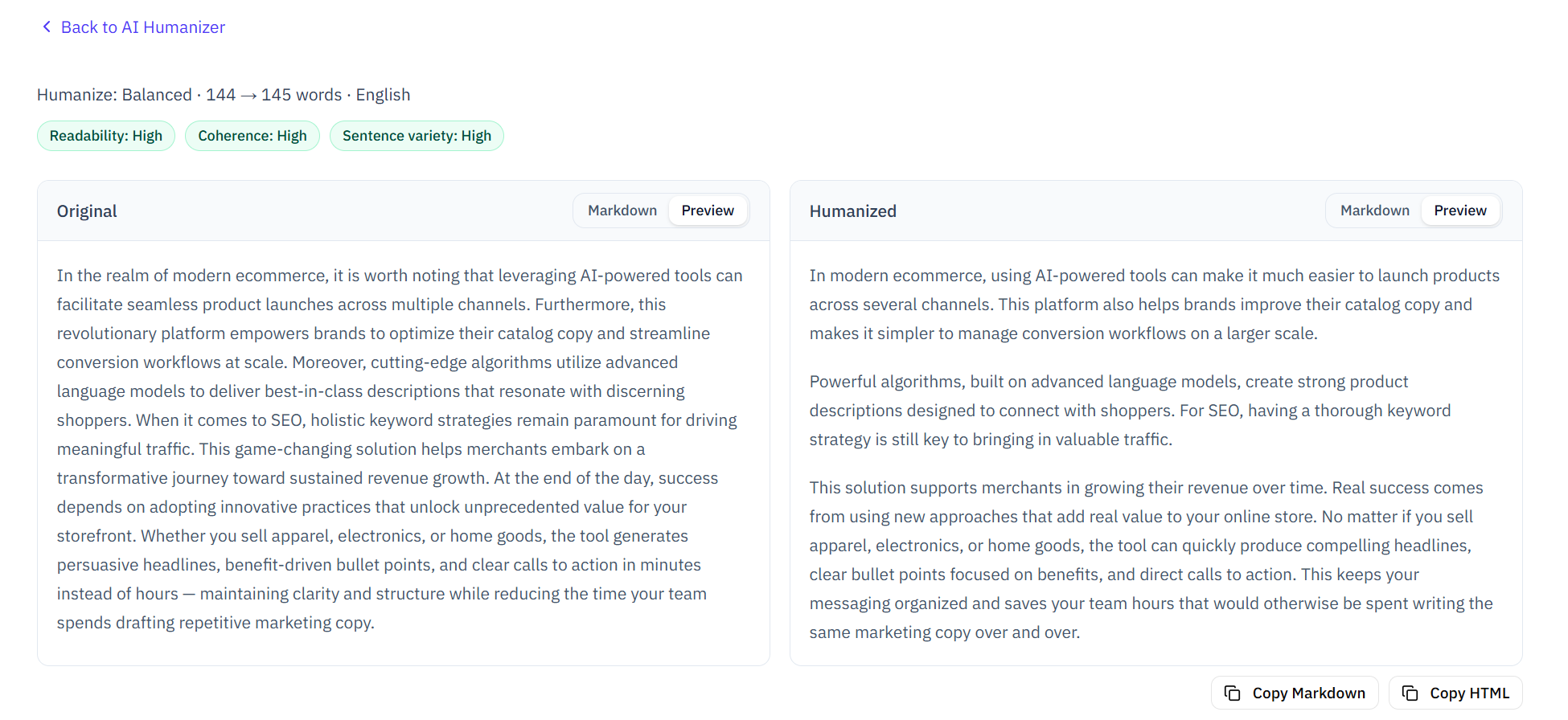
Naturalmelo takes a different approach from most humanizers: it integrates detection and humanization into a single workflow. You paste your text, the hybrid detection engine identifies AI-flagged sentences, and then you humanize with three intensity levels (Light, Balanced, Thorough). After humanization, you re-check the output immediately — no switching between tools.
The side-by-side comparison view shows exactly what changed: which words were replaced, which sentences were restructured, and which sections were merged or split. This transparency is rare in the humanizer space, where most tools show you the before and after without explaining the edits.
- Three humanization intensities: Light (minor phrasing tweaks), Balanced (restructures while preserving meaning), Thorough (deep rewrite, maximum pattern disruption)
- Built-in hybrid detector: 12 rule-based patterns + LLM review, no separate tool needed
- Edit categorization: See what changed — replaced, reordered, split, merged, deleted, or inserted words
- Free, no login: No account needed, no credit card, no usage limits beyond daily rate caps
- Quality signals: Readability, coherence, and sentence variety scores after humanization
Undetectable AI: The 23M-User Giant
Undetectable AI is the most popular dedicated humanizer on the market, with over 23 million users. It offers multiple readability levels (High School, University, Doctorate, Journalist, Marketing) and claims to bypass most major detectors. In our tests, its humanized output performed well on detection reduction — clearing roughly 70% of flagged sentences at its default settings.
However, Undetectable AI has a significant limitation: it does not include a built-in AI detector. To verify that your humanized text actually passes detection, you need a separate tool. This breaks the detect → fix → verify loop and forces you to juggle multiple tabs. The output quality was good but inconsistent — some passages read naturally, while others contained awkward phrasing that a human editor would catch immediately.
- 23M+ users, established brand with strong market presence
- Multiple readability levels targeting different audiences
- No built-in detector — requires external verification
- Paid plans start at $9.99/month; limited free tier with word count caps
- Output quality varies by content type — academic text more consistent than creative writing
WriteHuman, StealthWriter, and HumanizeAI: The Mid-Tier
WriteHuman, StealthWriter, and HumanizeAI occupy the middle of the market — better than simple paraphrasers, but not as polished as the top-tier tools. All three use similar underlying approaches: GPT-based rewriting with varying levels of prompt engineering for "human-like" output.
WriteHuman produced the most natural-sounding output of the three, with good sentence variety and fewer awkward constructions. StealthWriter was the most aggressive at restructuring but occasionally introduced factual errors — in one test, it changed "2023 study" to "recent research" and dropped the author name. HumanizeAI was fast and consistent but produced output that still carried detectable AI patterns in 40% of test cases.
- WriteHuman: Best output quality of the mid-tier, natural phrasing, but limited intensity control and no built-in detector
- StealthWriter: Most aggressive restructuring, good for breaking patterns, but higher factual error rate — verify names, dates, and numbers after using
- HumanizeAI: Fast and consistent output, but weaker detection reduction (40% of cases still flagged), and no side-by-side comparison view
Quillbot and Grammarly: Paraphrasers, Not Humanizers
Quillbot and Grammarly are often mentioned alongside humanizers, but they are fundamentally different tools. Quillbot is a paraphrasing engine — it rewrites sentences to avoid plagiarism, not to evade AI detection. Grammarly is a writing assistant that improves grammar, clarity, and tone. Neither is designed to reduce AI detection flags, and in our tests, neither meaningfully changed detection scores.
That said, both tools have a role in an AI writing workflow. Quillbot can help you vary sentence structure after humanization. Grammarly can clean up grammar and awkward phrasing that humanizers sometimes introduce. Think of them as complementary tools, not alternatives to a dedicated humanizer.
- Quillbot: Excellent paraphrasing for plagiarism avoidance, but AI detection scores unchanged in tests. Useful as a post-humanization sentence-variety tool.
- Grammarly: Industry-standard grammar and clarity checker. AI detection scores unchanged. Useful for polishing humanized output, not for reducing AI flags.
- Neither tool claims to bypass AI detection — they are writing aids, not humanizers. Using either as a humanizer will produce disappointing results.
At-a-Glance: 8 Humanizers Side by Side
Here is how each tool performed across our five evaluation criteria. Results are averaged across all five test passages at default settings.
Star ratings reflect our test results with 5 standard passages at default settings. Your results may vary depending on your text type, AI model used, and detection tool. No humanizer can guarantee a specific score — always verify output with a detector before submitting.
- Naturalmelo: ★★★★★ detection reduction (70–85%), ★★★★☆ output quality, ★★★★★ fact preservation. Built-in detector + re-check loop. Free, no login.
- Undetectable AI: ★★★★☆ detection reduction (~70%), ★★★☆☆ output quality, ★★★★★ fact preservation. No built-in detector. From $9.99/month.
- WriteHuman: ★★★★☆ detection reduction (~65%), ★★★★☆ output quality (best mid-tier prose), ★★★☆☆ fact preservation. No detector. Paid plans.
- StealthWriter: ★★★★☆ detection reduction (~70%, most aggressive restructuring), ★★★☆☆ output quality, ★★☆☆ fact preservation (errors in 2/5 tests). Paid plans.
- HumanizeAI: ★★★☆☆ detection reduction (~60%), ★★★☆☆ output quality, ★★★★☆ fact preservation. No comparison view. Paid plans.
- Quillbot: ★☆☆☆☆ detection reduction (negligible), ★★★★☆ output quality (for paraphrasing), ★★★★☆ fact preservation. Free tier available. Paraphraser, not humanizer.
- Grammarly: ☆☆☆☆☆ detection reduction (none), ★★★★★ output quality (grammar/clarity), ★★★★★ fact preservation. Free tier available. Writing aid, not humanizer.
- Netus AI: ★★★☆☆ detection reduction (~50%), ★★★☆☆ output quality, ★★★★☆ fact preservation. Less consistent than top-tier tools. Paid plans from $19/month.
Which Humanizer Should You Choose? A Decision Framework
The best humanizer depends on your specific situation. Here is a decision framework based on what matters most to you:
If you are a student submitting work that will be checked by Turnitin: Choose a tool with a built-in detector and re-check loop. Turnitin's August 2025 update added bypasser detection (purple highlights for humanized/paraphrased text), so you need to verify that your humanized output does not trigger this. The detect → fix → verify cycle is essential — a tool without a built-in detector leaves you guessing.
If you are a content marketer publishing at scale: Output quality matters more than maximum detection reduction. Choose a tool that preserves factual accuracy and maintains a consistent brand voice. Lighter humanization intensities often produce better-quality output than aggressive restructuring.
If you are a casual user who occasionally wants to polish AI-assisted writing: A free tool with a good built-in detector is your best option. You do not need maximum detection reduction — you need to identify which sentences sound templated and fix them selectively.
If you are on a tight budget: Free tools with built-in verification (like Naturalmelo) give you more control than paid tools without verification. A free tool that lets you re-check your output beats a paid tool that leaves you uncertain.
Quick Tips
Always re-check humanized output. Do not trust a humanizer’s claim that output is "undetectable." Run it through an independent detector. A tool that claims to bypass detection but does not include a detector is a red flag.
Match intensity to your use case. Match intensity to your use case: Light humanization preserves more of your original voice and is suitable for personal writing. Thorough humanization maximizes pattern disruption but may degrade quality — reserve it for high-stakes submissions.
Verify facts after humanization. Verify facts after humanization: Aggressive humanizers sometimes change names, dates, and statistics. Always proofread the output against your original — especially for academic and professional writing.
Use humanization as a revision step, not a magic button. Use humanization as a revision step, not a magic button: The best results come from writing a draft yourself (with or without AI assistance), running it through a detector, humanizing flagged sections, and then manually editing the result. Human-in-the-loop consistently outperforms fully automated approaches.
Frequently Asked Questions
Common questions about AI humanizer tools and how to choose the right one.
Q: What is the best free AI humanizer?
Naturalmelo is the strongest free option because it combines a hybrid detection engine with three humanization intensities and lets you re-check output immediately — no switching between tools. Most other free humanizers limit word count, strip features behind paywalls, or lack built-in verification. A free tool with a built-in detector gives you more control than a paid tool without one.
Q: Can an AI humanizer make my text completely undetectable?
No humanizer can guarantee your text will pass every detector. Detection models are constantly updated — Turnitin added bypasser detection in August 2025 specifically to catch humanized text. The cat-and-mouse dynamic means yesterday’s technique can become tomorrow’s detection target. The most reliable approach is human-in-the-loop: use a humanizer to reduce templated phrasing, then manually edit the output, then verify with a detector.
Q: How do I know if a humanizer actually worked?
The only way to know is to re-check the output with an AI detector. A humanizer that does not include a built-in detector or let you paste output into one forces you to guess. Look for tools that integrate detection and humanization — the detect → fix → verify loop is the gold standard for a reason.
Q: What’s the difference between a humanizer and a paraphraser?
A humanizer is designed to reduce AI detection flags by breaking templated writing patterns (hollow openings, stacked connectors, uniform sentence rhythm, hype phrases). A paraphraser is designed to avoid plagiarism by rewording text while preserving meaning. A paraphraser may change words but often leaves the underlying AI sentence structure intact — which means detectors still flag it. Humanizers target the structural patterns that detectors look for, not just the word choice.
Try the detect-fix-verify loop yourself
Paste your text, check which sentences are flagged, humanize at the intensity you choose, and re-check — all on one site, no login.
Try Naturalmelo AI Humanizer