
Resource
How to Reduce AI Writing Flags: A Step-by-Step Guide
Follow 5 concrete steps to reduce template-like phrasing, hollow transitions, and monotonous rhythm in your AI-assisted drafts — using pattern-level feedback and humanize tools on Naturalmelo.
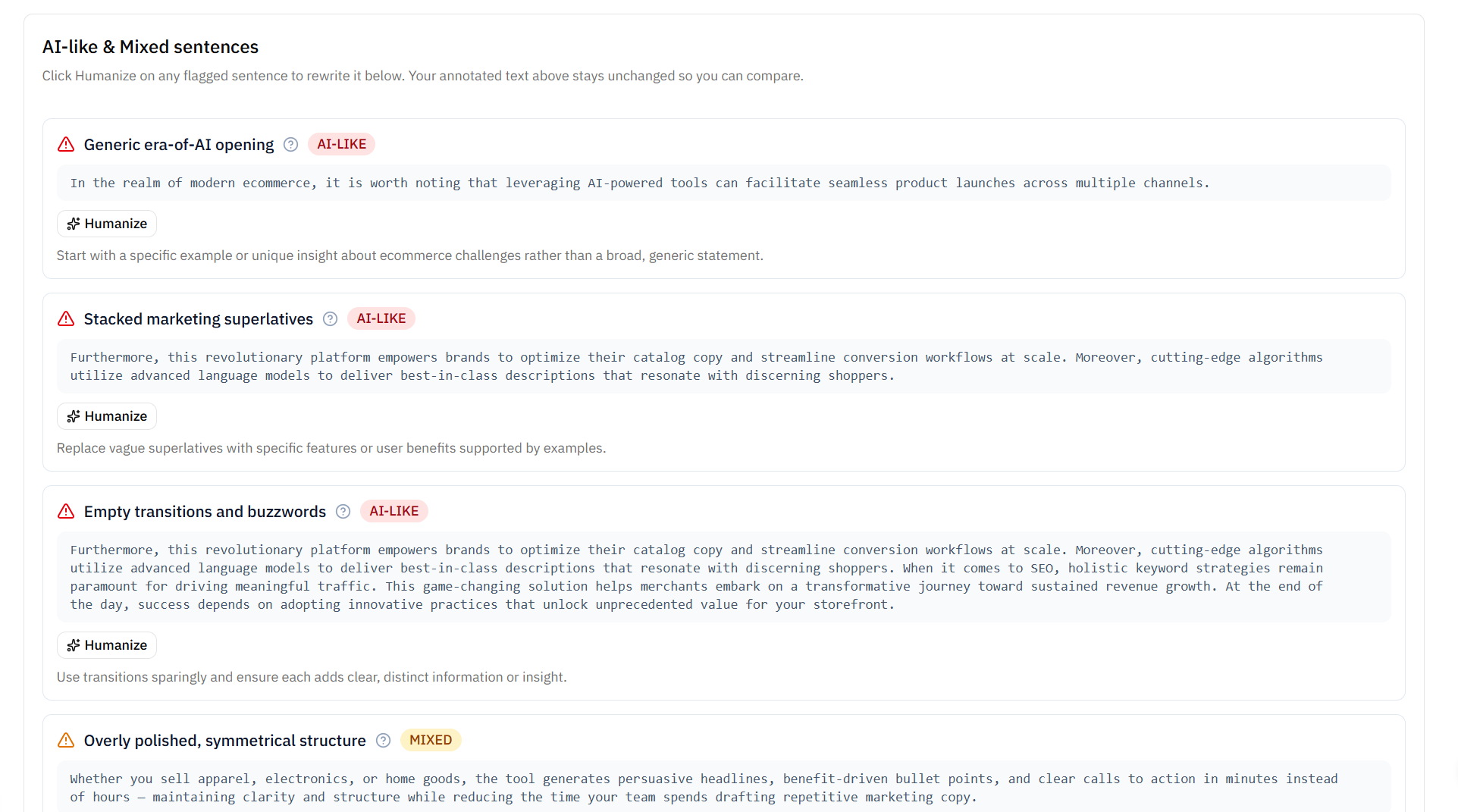
Sentence-level detail card showing severity tier, category tip, and rewrite hint
Step 1 — Run an AI writing check to see what is flagged
Before you can fix template-like phrasing, you need to know where it is. Paste your draft (50–1,000 words) into the AI writing checker and get a full report showing AI Writing %, sentence-level Human-like/Mixed/AI-like labels, and category tips on each hit.
- Choose General mode for everyday writing or Academic mode for papers and essays
- Review the AI Writing % at the top of your report
- Scan the AI-like and Mixed sentence counts to understand severity
- Click highlighted text in the annotated view to jump to each flag's detail card
Step 2 — Humanize flagged sentences one by one
Each flagged sentence in your report has a Humanize button. Click it to rewrite that sentence in the card below — your annotated text above stays unchanged so you can compare. Copy the rewritten sentence or continue to the next flag.
While editing manually requires you to guess what sounds "AI-like" and rewrite from scratch, sentence-level Humanize gives you a targeted rewrite for each specific flag — showing you exactly what changed and why.
- Start with AI-like (strong signal) sentences — they need the most attention
- Move to Mixed sentences — these may only need light rewording
- Copy rewritten sentences as you go, or let them accumulate in the card
- Each Humanize takes under 5 seconds per sentence
Step 3 — Run a full-draft humanize pass if needed
If many sentences are flagged or you want broader rhythm and flow improvements, open the full-draft Clever AI Humanizer. Your text carries forward automatically. Pick intensity: Balanced is recommended for most drafts.
- Light: smallest changes, keeps original sentence structure
- Balanced: recommended for most AI-assisted drafts
- Thorough: when the draft still sounds robotic after Balanced
- Review the side-by-side comparison before copying
Step 4 — Re-check to confirm improvement
Humanizing without measuring is guesswork. Run the AI writing checker again on your humanized output to see whether flagged sentence counts and AI Writing % actually dropped. This closes the detect → fix → verify loop.
- Compare before/after AI Writing %
- Check whether AI-like sentence count decreased
- Look for any new flags introduced by the rewrite (rare but possible)
- Repeat Steps 2–4 if needed — most drafts are clean within 1–2 cycles
Step 5 — Prevent future flags with better prompting
The best way to reduce AI flags is to produce fewer template patterns in the first place. Adjust your AI writing prompts to encourage varied sentence structure, specific examples, and natural transitions — rather than the stacked connectors and hollow openings that detectors flag.
- Ask the AI to vary sentence length — mix short and long sentences
- Request specific examples and data points instead of generic claims
- Avoid prompting for "formal academic tone" — this often produces template phrasing
- Write section transitions in your own words rather than accepting AI-generated ones
- Always run a detection check as the final step before submission
Quick tips for reducing AI flags
Target AI-like sentences first. Strong signals contribute most to a high AI Writing %. Fix these and your score drops fastest.
One cycle is often enough. Most drafts reach a clean state after one detect → humanize → re-check cycle. Do not over-polish.
Academic mode is more forgiving. Academic mode expects formal language — it flags only template filler, not scholarly vocabulary.
Keep your own voice in transitions. The most commonly flagged pattern is hollow transitions. Rewrite these manually for best results.
Reducing AI Flags FAQ
Common questions about reducing AI writing flags on Naturalmelo.
What is the fastest way to lower my AI Writing %?
Target AI-like (strong signal) sentences first. Humanizing just the 2–3 strongest flags often drops the AI Writing % by 20–30 points because the score weights strong signals more heavily than Mixed ones. Then re-check to confirm.
Why do some sentences get flagged even after humanizing?
Humanizing reduces template phrasing but does not eliminate all patterns — especially if the original text was heavily templated. A second pass with Thorough intensity, or manual rewriting of stubborn sentences, usually resolves remaining flags.
Does sentence-level Humanize produce different results than full-draft Humanize?
Yes. Sentence-level Humanize rewrites one sentence at a time with minimal surrounding context. Full-draft Humanize considers the broader paragraph flow, producing more cohesive output. Use sentence-level for targeted fixes and full-draft for overall rhythm improvement.
How do I know when my draft is "clean enough"?
There is no universal threshold — it depends on your context. For a casual blog post, a few Mixed flags may be fine. For academic submission, aim for zero AI-like flags and minimal Mixed ones. The AI Writing % is a guide, not a pass/fail verdict.
Start reducing your AI writing flags
Paste your draft on Naturalmelo, see which sentences are flagged, and humanize them in under 30 seconds per flagged sentence.
Run AI writing check