Resource

Can AI Detectors Be Wrong? Understanding False Positives in AI Detection

False positives affect roughly 20% of human-written text — especially for non-native English speakers, formal writers, and students. Learn why detectors misclassify original work and what to do if you're wrongly flagged.

July 29, 2026 · Naturalmelo Team

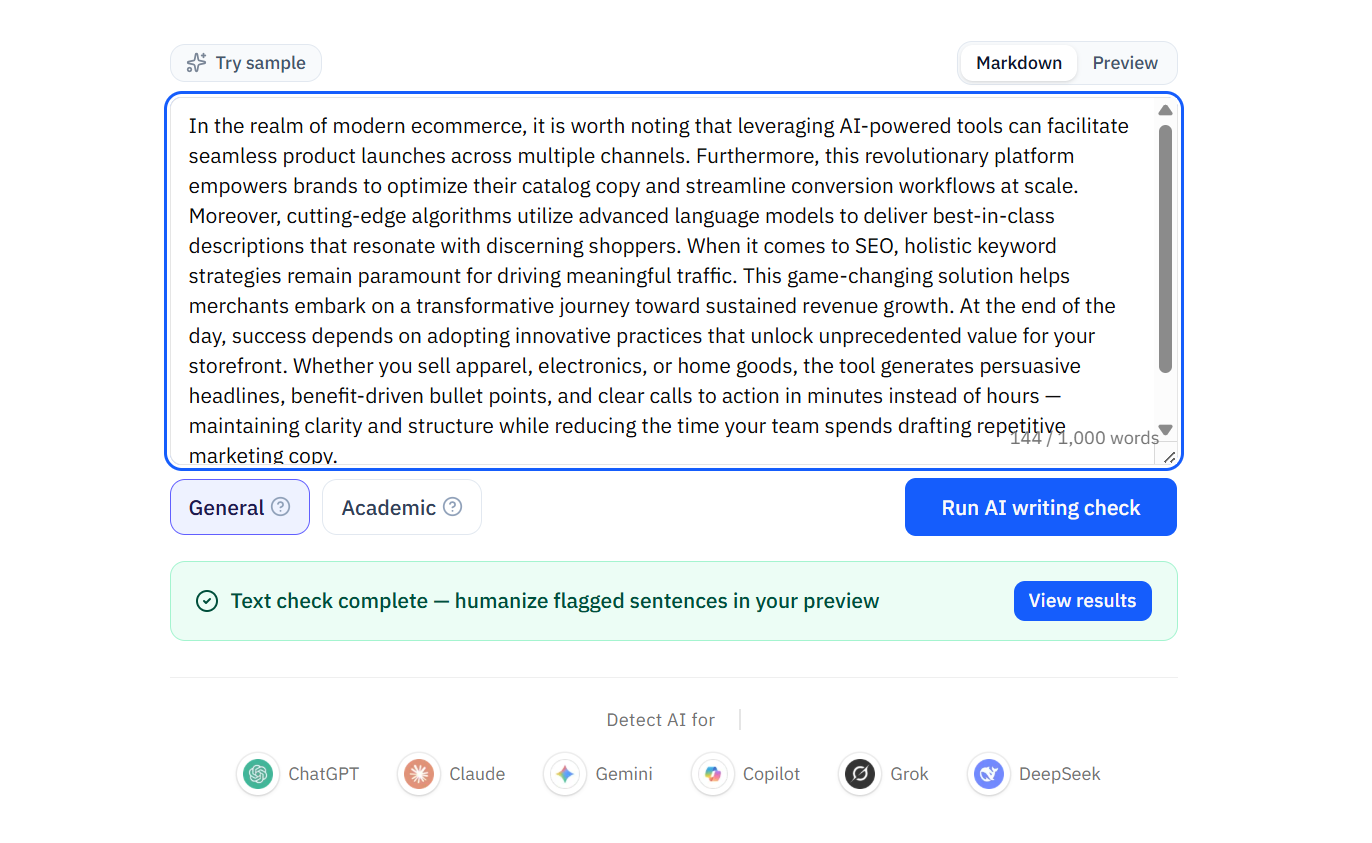
Sentence-level AI detection results with pattern-based highlighting

What Is a False Positive in AI Detection?

A false positive in AI detection occurs when a detector flags human-written text as AI-generated. The detector reports "this text has AI-consistent patterns" but the text was written entirely by a person. The consequences range from wasted time (explaining yourself to an instructor) to serious academic consequences (failing an assignment, facing an integrity hearing).

The industry-wide false positive rate is estimated at around 20% — meaning roughly one in five human-written documents triggers some level of AI detection. This is not because detectors are broken; it is because the statistical properties they measure (perplexity, burstiness, pattern frequency) overlap significantly between certain types of human writing and typical AI output. The problem is not the measurement — it is treating the measurement as definitive.

Turnitin acknowledges this by suppressing scores below 20% (showing an asterisk * instead) to reduce the number of borderline false positives that instructors see. But suppression is not the same as accuracy — a suppressed score still means the model detected AI-like patterns, it just means Turnitin chose not to show them.

Why False Positives Happen: The Three Main Causes

False positives are not random errors — they follow predictable patterns. Understanding these patterns helps you recognize when your writing is at risk and what to do about it.

All three causes share the same root issue: detectors measure statistical properties, not authorship. When those statistical properties overlap between human and AI writing — which they do, frequently — the detector has no way to distinguish between them. It reports the statistical similarity and leaves the interpretation to humans.

  • Cause 1 — Formal writing overlaps with AI training data: LLMs are trained on formal, well-structured text — academic papers, Wikipedia articles, professional reports. When a human writes in a formal register, their statistical word-choice patterns naturally resemble the data the models were trained to reproduce. The detector is not wrong that the text "looks like AI output" — it is correctly identifying the similarity. The error is concluding that similarity implies AI authorship.
  • Cause 2 — Non-native English has lower lexical diversity: ESL writers tend to use more predictable word choices, simpler sentence structures, and fewer idiomatic expressions — all of which reduce perplexity and burstiness, the two metrics most detectors rely on. Research from Stanford HAI and others has consistently found that non-native English writing is flagged at roughly 2× the rate of native-speaker writing. This is a systemic bias built into the statistical approach, not an individual failing.
  • Cause 3 — Editing removes human idiosyncrasy: Human writing in its raw form is messy — uneven sentences, inconsistent structure, quirky word choices. Multiple rounds of editing (especially with tools like Grammarly) smooth out these idiosyncrasies, making the text more uniform and predictable — which makes it look more like AI output to a statistical detector. The irony: the more you polish your writing, the more likely it is to be flagged.

Who Gets Flagged Most Often

The question of who gets flagged is not just about technology — it is about equity. Research consistently shows that certain groups are disproportionately affected by AI detection false positives:

  • Non-native English speakers: Flagged at approximately 2× the rate of native speakers. The linguistic features that detectors associate with AI (predictable word choice, simpler structures, less idiomatic language) overlap heavily with the features of non-native English writing. This creates a systemic disadvantage that is built into the detection approach, not correctable through better prompting or individual effort.
  • Students writing in formal academic registers: Students who have been explicitly taught to write in a formal, structured academic style are penalized for doing exactly what their education trained them to do. The irony is sharp: the student who follows every academic writing convention is the student most likely to trigger an AI detector.
  • Neurodivergent writers: Writers with autism, ADHD, or other neurotypes may produce text with statistical patterns (consistent structure, formal register, limited idiom use) that detectors associate with AI. This is an under-researched but increasingly recognized dimension of detection bias.
  • Students who use grammar tools heavily: Running text through Grammarly, ProWritingAid, or similar tools multiple times smooths out the idiosyncrasies that signal human authorship. A student who edits diligently — following every grammar suggestion — may inadvertently make their writing look more AI-generated.

Turnitin, GPTZero, and Grammarly: How Accurate Are They?

Different detectors have different false positive profiles. Here is what independent research and user reports tell us about the most commonly used tools:

  • Turnitin: Claims 1% document-level false positive rate, but this is widely contested. Independent researchers find higher rates for formal academic prose and ESL writing. Turnitin addresses this with score suppression (scores below 20% shown as *) and by training instructors NOT to treat scores as definitive. The August 2025 bypasser detection (purple highlights) adds a new dimension — humanized text may trigger a different kind of flag rather than avoiding detection entirely.
  • GPTZero: Uses perplexity + burstiness at multiple granularities (sentence, paragraph, document). More transparent than Turnitin — shows exactly which sentences contribute to the score. Independent testing suggests false positive rates of 10–20%, with higher rates for formal and non-native writing. GPTZero Education provides additional context (writing process evidence, prior submissions) that individual users cannot access.
  • Grammarly's AI detector (beta): Grammarly added AI detection to its premium tier in 2024. Since Grammarly's core product is about improving writing — reducing errors, standardizing style, improving clarity — there is an inherent tension: using Grammarly for editing makes text more detectable, and Grammarly's own detector may then flag the text its editing tool helped create. Independent testing suggests high false positive rates for text that has been through multiple rounds of Grammarly editing.
  • Copyleaks: Supports 30+ languages — the widest language coverage. Uses linguistic pattern analysis rather than pure statistical modeling. Tends to have higher false positive rates on English academic text than Turnitin or GPTZero, but is the only viable option for many non-English use cases.

What to Do If You're Wrongly Flagged: A 5-Step Plan

Being wrongly flagged by an AI detector is stressful, but panicking makes things worse. Here is a systematic approach to addressing a false positive accusation:

Step 1 — Do not panic and do not delete anything: Deleting drafts, version history, or AI conversations looks like destruction of evidence. Keep everything. Your writing process is your strongest defense.

Step 2 — Ask to see the specific report: You have the right to know exactly what was flagged and why. Ask which sentences triggered the detector and what score was assigned. If the score is in the 20–40% range, note that this is the range where most false positives occur.

Step 3 — Gather your process evidence: Pull up Google Docs version history showing incremental edits over time. Collect your research notes, outlines, and earlier drafts. The progression from rough outline → messy draft → revised draft → final version is evidence no detector can refute.

Step 4 — Request a conversation, not a ruling: Ask to discuss your work verbally. Walk through your argument, explain your sources, and discuss your writing choices. The ability to explain your own work is the most powerful evidence of authorship.

Step 5 — Know your rights: Most institutions now have policies stating that AI detection scores alone are insufficient grounds for academic integrity actions. Ask for a copy of your school's AI policy. If your institution does not have one, request that they develop one — the lack of policy is a problem for them, not just for you.

How to Protect Yourself Proactively

The best time to prepare for a false positive is before it happens. These practices create the paper trail that makes false accusations easy to resolve:

  • Write in Google Docs with version history enabled: Every edit, deletion, and restructuring is timestamped. A document that shows gradual development over days or weeks is nearly impossible to dispute. Large text blocks that appear fully formed at 2 AM with no prior edits are the opposite.
  • Save your drafts, not just your final version: Keep outline drafts, rough drafts, revision drafts. Each version should be visibly different — the progression from messy to polished is the evidence. AI-generated text does not "progress" — it arrives.
  • Self-check your writing before submission: Run your draft through an independent AI checker like Naturalmelo. If sentences are flagged, you have the opportunity to revise them — or at minimum, to know what an instructor might see and prepare your explanation.
  • Document your AI use, if any: If you used AI for brainstorming, outlining, or editing, keep a log: "Used ChatGPT to brainstorm thesis ideas on [date], then wrote the essay myself." Specific, honest disclosure builds credibility. Blanket denial of any AI use — especially when a report shows strong signals — can erode trust.
  • Understand your school's AI policy before you submit: Every institution handles AI differently. Some have explicit policies; others have vague guidelines. Know what applies to you. If your school has no policy, awareness of that gap is itself valuable — it means any accusation is navigating uncharted territory.

The Bigger Picture: Equity, Trust, and the Future of AI Detection

False positives in AI detection are not just a technical problem to be solved with better models. They are an equity problem. When detection systems disproportionately flag the writing of non-native speakers, students who follow academic conventions, and writers whose neurotypes produce different statistical patterns — the technology is not neutral. It encodes assumptions about what "human writing" looks like, and those assumptions reflect the training data, not the full diversity of human expression.

Several universities have responded to this concern by making AI detection optional for instructors or by prohibiting its use as sole evidence in academic integrity cases. The MLA and CCCC (Conference on College Composition and Communication) issued a joint statement in 2025 urging institutions to treat detector scores as "investigatory leads, not evidentiary conclusions" — a standard that most institutions now follow in practice if not in policy.

The direction of travel is clear: detection is becoming a feedback signal, not a judgment. The goal is not to catch students — it is to help them write more authentically. A detector that says "these four sentences sound templated — try rewriting them in your own voice" is a writing tool. A detector that says "this student cheated" is a liability. The difference is how the output is used.

The most important shift in thinking about AI detection is this: the detector is not the problem. How institutions use detector output is the problem. A detector score used as a conversation starter ("let's discuss your writing process") supports learning. The same score used as a verdict ("you cheated") undermines it. Students, educators, and institutions all have a stake in pushing toward the former and away from the latter.

Quick Tips

Document your writing process. Use Google Docs with version history for all academic writing. The progression from outline to draft to final version is evidence no detector can dispute.

Self-check before submitting. Run your draft through an independent checker like Naturalmelo. Knowing what an instructor might see gives you the chance to revise flagged sentences proactively.

Know your school's AI policy. Every institution handles AI detection differently. Some treat scores as conversation starters; others have formal adjudication processes. Know which applies to you.

If flagged, lead with your process, not your denial. Saying "I didn't use AI" is less convincing than saying "here are my three drafts from October 5, 8, and 12 — you can see how my argument developed."

Frequently Asked Questions

Common questions about false positives in AI detection.

Q: What should I do if Turnitin says I used AI but I didn't?

Stay calm and follow the five-step plan: (1) do not delete anything — your writing process is your defense; (2) ask to see the specific report — which sentences were flagged, what score, cyan or purple highlights; (3) gather process evidence — Google Docs version history showing incremental development over time; (4) request a conversation about your work, not a ruling on a score; (5) know your rights — most institutions now require more than a detector score for academic integrity actions. The vast majority of false positive cases are resolved in the student's favor when they can demonstrate their writing process.

Q: Is Quillbot's AI detector accurate?

Quillbot's AI detector is a relatively new addition to their platform (added alongside their paraphrasing and grammar tools). Independent testing suggests it has higher false positive rates than more established detectors like GPTZero. Like all detectors, it is less accurate on formal writing, non-native English, and heavily edited text. It is best used as a rough screening tool rather than a definitive check — and results should always be verified with a second detector before drawing conclusions.

Q: Why does Grammarly trigger AI detection flags?

Grammarly improves writing by standardizing grammar, smoothing out awkward constructions, and enforcing consistent style — which inadvertently removes the idiosyncrasies that distinguish human writing from AI output. Text that has been through multiple rounds of Grammarly editing has lower burstiness and more uniform structure, making it more detectable. This creates an ironic loop: using Grammarly to improve your writing may cause detectors to flag it, and Grammarly's own AI detector may then flag text that Grammarly's editor helped polish.

Q: Can I prove that my writing is human-written?

Yes — through process evidence rather than word-choice evidence. The strongest proof is Google Docs version history showing incremental development over time: rough outline → messy first draft → revised draft → polished final. AI-generated text appears fully formed; human writing develops. Additional evidence includes research notes, earlier drafts with different arguments or structures, and the ability to verbally explain your writing choices. No detector score can compete with a demonstrated writing process.

Self-check your writing before submission

Use Naturalmelo's free AI checker to see which sentences might trigger detection — then revise in your own voice and re-check. No login required.

Run AI writing check