
Recursos
Detección de IA en Common App: lo que los aspirantes universitarios deben saber en 2026
¿Common App revisa tu sección de actividades en busca de IA? ¿Los oficiales de admisión pasan detección a las cartas personales? Esto es lo que necesitas saber.
Publicado 29 de julio de 2026 · Equipo Naturalmelo
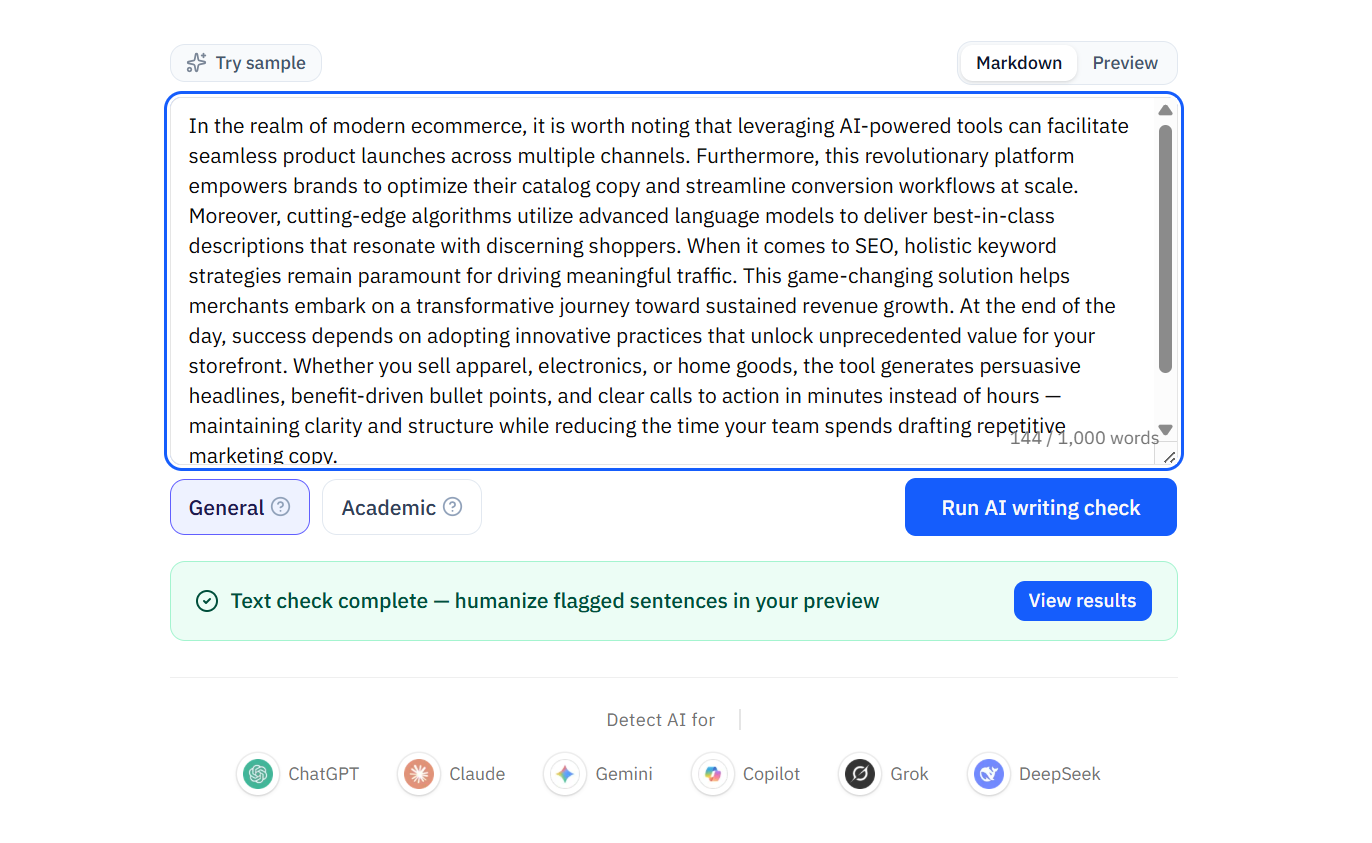
Detección de IA a nivel de oración con resaltado basado en patrones
Lo que Common App realmente dice sobre la IA
La posición oficial de Common App sobre la IA está integrada en su declaración de certificación — el párrafo que todo aspirante debe firmar antes de enviar. En el ciclo de solicitud 2025–2026, la certificación establece que todo el trabajo entregado debe ser propio del aspirante y que «toda la información enviada en la solicitud es mi propio trabajo.» Common App no ha emitido una política separada específica de IA, pero la certificación existente cubre el contenido generado por IA: entregar un ensayo que no escribiste — ya sea por un humano o por una IA — viola los términos.
Common App en sí no corre detección de IA sobre los materiales enviados. La plataforma no escanea ensayos, descripciones de actividades ni ningún otro campo con un detector de IA. La detección ocurre a nivel de cada universidad — si ocurre. Common App es un conducto, no un portero. Cuando envías por Common App, tus materiales van a la oficina de admisiones de cada universidad, donde las instituciones individuales aplican sus propias políticas y (potencialmente) sus propias herramientas de detección.
Esta distinción importa: no hay un filtro automático de IA a nivel de Common App que rechace tu solicitud antes de que un humano la vea. La pregunta no es «¿Common App detectará IA?» sino «¿las universidades a las que postulo revisarán — y qué harían si encontraran contenido generado por IA?»
¿Common App revisa la sección de actividades en busca de IA?
La sección de Activities presenta un desafío único de detección — tanto para aspirantes como para oficiales de admisión. Cada entrada de actividad está limitada a 150 caracteres, incluidos espacios. A esa longitud, simplemente no hay texto suficiente para una detección estadística significativa de IA. La perplejidad y el burstiness requieren contexto; un bullet de 150 caracteres no lo da.
Lo que los oficiales de admisión buscan no es detección de IA en sí — es consistencia. Leen la sección de Activities junto al ensayo personal, los ensayos suplementarios y las cartas de recomendación. Si la voz de tu ensayo personal es sofisticada y literaria, pero tus descripciones de actividades se leen como un comunicado corporativo, un lector experimentado nota la brecha. El riesgo no es una puntuación de detector de IA — es un lector humano sintiendo que distintas secciones las escribieron distintos «escritores.»
El consejo práctico: escribe tus descripciones de actividades en tu propia voz, usando el mismo vocabulario y patrones de oración que usas en el resto de la solicitud. Si tu ensayo personal describe «ayudar a niños a aprender a leer» con calidez y anécdotas concretas, tu sección de actividades no debería decir «facilitated literacy development programming for under-resourced youth populations.» La consistencia de voz es la señal; la inconsistencia es la bandera roja.
El ensayo personal: donde más importa la detección de IA
El ensayo personal de Common App de 650 palabras es el elemento más detectable por IA de tu solicitud — y aquel donde el uso de IA tiene más consecuencias. Con 650 palabras hay texto suficiente para que la detección estadística produzca resultados significativos (aunque imperfectos). Más importante aún, los oficiales de admisión leen miles de ensayos por ciclo y desarrollan un oído para la autenticidad que ningún detector puede replicar.
Los ensayos personales generados por IA tienen un perfil reconocible: son estructuralmente perfectos pero emocionalmente planos. Cuentan en lugar de mostrar. Usan epifanías genéricas («aprendí que el trabajo en equipo es la clave del éxito») en lugar de momentos concretos. Empiezan con afirmaciones amplias («In today's interconnected world...») y terminan con resoluciones ordenadas. Los ensayos personales reales son más desordenados — empiezan en medio de un momento, incluyen detalles que no «encajan» de inmediato pero se sienten verdaderos, y a veces terminan sin una lección pulcra.
Los oficiales de admisión no pasan cada ensayo por Turnitin — la mayoría no pasa ninguno por software de detección. Están leyendo. Y los lectores experimentados pueden detectar ensayos generados por IA con una precisión sorprendente, no porque sean expertos en detección, sino porque los ensayos de IA carecen de la gravedad específica de la experiencia vivida. Un ensayo real sobre un momento concreto en un lugar concreto con personas concretas es difícil de falsificar, incluso para una IA.
Los ensayos personales más fuertes son a prueba de IA por naturaleza — no porque evadan la detección, sino porque la detección les es irrelevante. Un ensayo sobre el verano en que reconstruiste una motocicleta con tu abuelo, escrito en tu voz real con detalles sensoriales concretos y un final honesto, no necesita preocuparse por la detección de IA. Ningún detector marca la especificidad auténtica.
¿Las universidades realmente revisan los ensayos de solicitud en busca de IA?
La respuesta corta: algunas sí, la mayoría no, pero todas están atentas. Una encuesta de 2025 a oficinas de admisión de la National Association for College Admission Counseling (NACAC) encontró que alrededor de un cuarto de las universidades ha pasado al menos algunos ensayos de solicitud por software de detección de IA — frente a menos del 10% en 2024. Las universidades públicas grandes con alto volumen de solicitudes son las más propensas a usar filtros automáticos; las facultades liberales pequeñas con revisión holística son las menos propensas.
La estadística más relevante es esta: dos tercios de los oficiales de admisión reportaron haber «sospechado uso de IA» en al menos un ensayo durante el ciclo anterior — no por una puntuación de detector, sino por la calidad de la escritura. Ensayos genéricos, ensayos que podría haberlos escrito cualquiera sobre cualquier cosa, ensayos con gramática perfecta y sin personalidad — estos activan la sospecha humana con más fiabilidad que cualquier software.
Las universidades que sí usan detección de IA tienden a usarla como bandera, no como filtro. Una puntuación alta de IA en un ensayo provoca una lectura más atenta, no un rechazo automático. El oficial mira el resto de la solicitud: ¿las calificaciones coinciden con la calidad de la escritura? ¿Las recomendaciones de maestros describen a un estudiante que escribe a este nivel? ¿El trasfondo y la experiencia del aspirante se alinean con el contenido del ensayo? La puntuación del detector es un dato en una revisión holística — y rara vez el decisivo.
Qué pasa si se detecta uso de IA en tu solicitud
Ninguna universidad declara públicamente que rechaza automáticamente aspirantes por una puntuación de detección de IA. El resultado más común es que el ensayo se descuenta — el oficial de admisión lo deja mentalmente de lado y evalúa el resto de la solicitud sin la contribución del ensayo. En un entorno competitivo de admisiones, perder el ensayo significa perder tu oportunidad principal de diferenciarte. La sanción no es un rechazo formal por uso de IA; es una oportunidad desperdiciada de contar tu historia.
En algunos casos — particularmente cuando el uso de IA es flagrante (un ensayo que no tiene relación con el trasfondo del aspirante, contiene detalles fabricados o es claramente un copy-paste) — las universidades pueden marcar la solicitud por preocupaciones de integridad. Es raro pero no inaudito. Algunas universidades se reservan el derecho de revocar una oferta de admisión si se descubre uso de IA después de la aceptación, especialmente si la certificación de la solicitud se firmó bajo falsas pretensiones.
El riesgo más significativo no es la detección — es la mediocridad. Un ensayo generado por IA que pasa la detección sigue siendo un ensayo generado por IA: genérico, pulido y olvidable. Los oficiales de admisión leen para encontrar una razón para admitirte. Un ensayo genérico no les da ninguna. Un ensayo auténtico — incluso uno desordenado — sí les da una razón.
Cómo escribir un ensayo auténtico que se sostiene solo
La mejor defensa contra las preocupaciones de detección de IA es escribir un ensayo que sea inconfundiblemente tuyo. Así se ve en la práctica:
- Empieza con un momento concreto, no con un tema general: «El verano en que cumplí quince, mi abuela me enseñó a hacer tamales» es un ensayo real. «El liderazgo es una cualidad importante que he desarrollado a través de varias experiencias» es un ensayo de IA. La especificidad es tu superpoder — empieza con el momento, no con la lección.
- Incluye detalles sensoriales que solo tú conocerías: Cómo olía la cocina. La canción que sonaba. Exactamente lo que dijo tu abuelo que te hizo reír. Esos detalles anclan tu ensayo en la realidad. La IA puede generar detalles sensoriales genéricos; no puede generar TUS detalles sensoriales.
- Deja que tu ensayo sea desordenado: Las historias reales no tienen estructuras ordenadas de tres puntos. Tu ensayo puede empezar a la mitad, dar vueltas, dejar preguntas sin responder. Los oficiales de admisión no califican estructura — leen buscando voz. Un ensayo estructuralmente imperfecto con voz clara vence a un ensayo perfectamente estructurado sin voz.
- Escribe como hablas — luego edita por claridad, no por formalidad: Tu ensayo debe sonar a ti, no a un libro de texto. Usa palabras que realmente uses. Si no dices «furthermore» en conversación, no lo pongas en tu ensayo. Lee tu ensayo en voz alta. Si suena a otra persona leyendo un guion, reescríbelo.
- Haz que alguien que te conoce lo lea y pregunte: «¿Esto suena a [tu nombre]?» Si dudan, reescribe. La mejor verificación de autenticidad no es un detector — es la persona que te ha oído contar historias.
Uso ético de IA en solicitudes universitarias
La línea entre uso aceptable e inaceptable de IA en solicitudes universitarias es más clara que en muchos contextos académicos. La solicitud es explícitamente una representación de tu propio trabajo, tus propias experiencias y tu propia voz. Las herramientas de IA que reemplazan tu pensamiento o escritura cruzan una línea ética clara.
Usos aceptables: Lluvia de ideas sobre temas de ensayo (preguntarle a ChatGPT «¿qué ángulos hay sobre una experiencia de voluntariado?» está bien — estás explorando posibilidades, no generando contenido). Feedback sobre claridad («¿tiene sentido este párrafo?» está bien; «reescribe este párrafo» no). Revisión gramatical (usar Grammarly para typos está bien; usarlo para estandarizar tu voz es contraproducente).
Usos inaceptables: Generar borradores o párrafos del ensayo. Usar IA para «mejorar» tu escritura haciéndola sonar más sofisticada. Usar un humanizador para evadir la detección — eso agrava el problema ético al añadir engaño al atajo original. Que la IA escriba tus descripciones de actividades.
La prueba más simple: si te sentirías incómodo diciéndole a un oficial de admisión «usé IA para esta parte de mi solicitud», no uses IA para esa parte. La incomodidad es la señal.
Un oficial de admisión está tratando de decidir si invitarte a su comunidad por cuatro años. Quiere saber quién eres. La IA no puede responder esa pregunta — solo tú puedes. Usar IA en tu solicitud no solo arriesga la detección; arriesga responder la pregunta más importante de tu solicitud con las palabras de otra persona.
Consejos rápidos
Empieza con un recuerdo, no con un tema. Los mejores ensayos personales comienzan con un momento concreto: una conversación, un fracaso, una revelación. Los temas generales («superar la adversidad», «el valor del trabajo duro») producen ensayos genéricos. Los momentos concretos producen ensayos concretos.
Escribe el primer borrador sin IA. Ni siquiera abras ChatGPT para tu primer borrador. Pon primero tus ideas y tu voz reales en la página. Luego puedes usar IA para feedback ligero sobre claridad — pero la base debe ser tuya.
Revisa la consistencia de voz en toda la solicitud. Tu ensayo personal, las descripciones de actividades y los ensayos suplementarios deben sonar como si los hubiera escrito la misma persona. Léelos juntos. Si las voces difieren, revisa para lograr consistencia.
Haz que alguien que te conoce lo lea en voz alta. Si dicen «esto no suena a ti», escucha. La mejor verificación de autenticidad es una persona que conoce tu voz. Un detector puede medir estadísticas; un amigo puede medirte a ti.
Preguntas frecuentes
Dudas comunes sobre detección de IA y solicitudes universitarias.
¿Common App revisa la sección de Activities en busca de contenido escrito por IA?
No. La plataforma Common App no corre detección de IA en ninguna parte de la solicitud. Con 150 caracteres por entrada de actividad, tampoco hay texto suficiente para una detección estadística significativa. Sin embargo, los oficiales de admisión leen la sección de actividades junto a tus ensayos y cartas de recomendación — notan inconsistencias de voz entre secciones, que es el riesgo real de usar IA en cualquier parte de tu solicitud.
¿Las universidades pasan detección de IA a los ensayos de solicitud?
Alrededor de un cuarto de las universidades reportó pasar al menos algunos ensayos por detección de IA en 2025, según NACAC — frente a menos del 10% en 2024. Las universidades públicas grandes con alto volumen de solicitudes son las más propensas a usar filtros automáticos. Sin embargo, la mayoría de las que usan detección la tratan como una bandera para una lectura más atenta, no como un filtro automático. Ninguna universidad tiene una política pública de rechazar automáticamente aspirantes por una puntuación de detección de IA.
¿Los oficiales de admisión pueden notar si mi ensayo es de IA sin usar software?
Sí, y ese es el riesgo más significativo. Los oficiales de admisión experimentados leen miles de ensayos por ciclo. Reconocen ensayos generados por IA por su calidad genérica — estructuralmente perfectos, emocionalmente planos, llenos de afirmaciones amplias y conclusiones ordenadas. Un ensayo que podría haberlo escrito cualquiera sobre cualquier cosa es tan ineficaz como uno marcado por software. La especificidad auténtica es tanto la mejor estrategia de escritura como la defensa más fuerte contra la sospecha.
¿Qué debo hacer si ya usé IA para escribir parte de mi solicitud?
Si ya enviaste: no entres en pánico. La mayoría de las universidades no corre detección sistemática de IA, y un solo pasaje marcado en una sección de respuesta corta es poco probable que afecte tu decisión de admisión por sí solo. Si aún no has enviado: reescribe tú mismo las secciones generadas por IA. Deja de lado la salida de IA y escribe desde tu propia memoria y experiencia. La reescritura casi con certeza será mejor — más específica, más personal, más convincente — que la versión de IA. Los oficiales de admisión buscan una razón para admitirte. Dales una real.
Revisa tus ensayos antes de enviar
Pasa tu ensayo personal y tus respuestas suplementarias por el detector de IA gratuito de Naturalmelo para ver si algún pasaje podría activar detección — luego revisa en tu voz auténtica.
Ejecutar análisis de escritura IA