Resource
How to Make AI-Generated Text Sound More Human: Techniques, Prompts, and Strategies Beyond Humanizer Tools
Practical techniques to humanize AI text — sentence rhythm, concrete language, smart prompts, and manual editing strategies that work better than automated humanizers alone.
June 15, 2026 · Naturalmelo Team
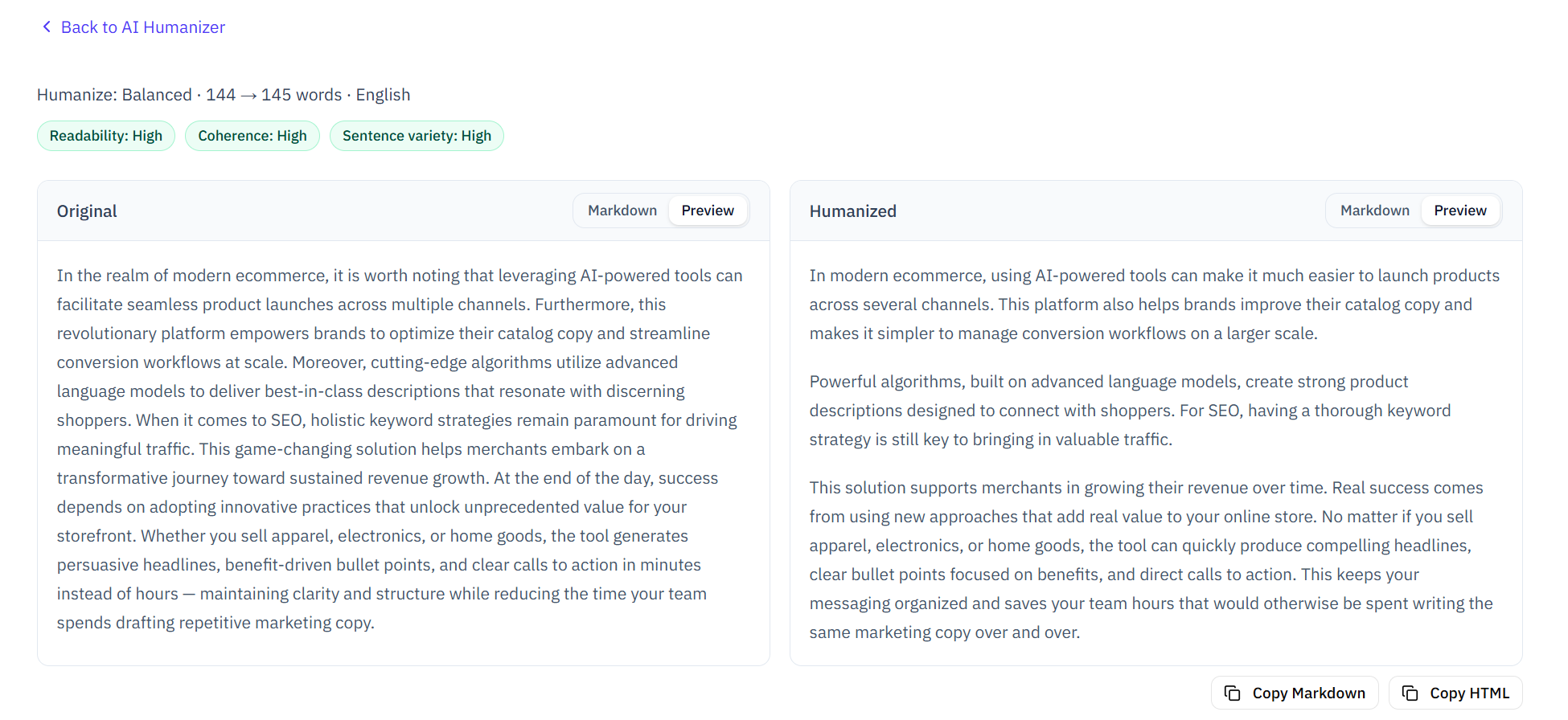
Side-by-side original vs humanized output comparison
Why Technique Matters More Than Tools
AI humanizer tools can help, but the most effective humanization happens at the writing level — through deliberate choices about sentence rhythm, word variety, concrete detail, and personal voice. These are techniques, not technologies. You can apply them with or without a humanizer tool.
The goal is not to "fool" a detector — it's to make your writing better. The same qualities that make writing sound human (specificity, variation, authentic voice) are also what make writing effective. Approaching humanization as a writing skill rather than an evasion tactic produces better results on both fronts.
Vary Your Sentence Rhythm
AI-generated text tends toward uniform sentence length and structure. Every paragraph has three to four sentences. Every sentence is medium length. This uniformity is a strong statistical signal for AI detection. Human writing breathes — long sentences followed by short ones. Fragments. Run-ons. Variety.
Practical technique: After writing a draft, read it aloud. If you hear yourself reading sentences of the same length and rhythm, break the pattern. Follow a long, complex sentence with three words. Start a paragraph with a fragment. Let the writing breathe.
Replace Generic Language with Concrete Specifics
AI writing defaults to the generic. "Many studies have shown..." instead of naming a study. "Experts believe..." instead of quoting an expert. "The data indicates..." instead of showing the data. These generic references are both poor writing and strong AI signals.
Practical technique: For every generic reference in your draft, ask "which one?" If you wrote "studies show," find a specific study. If you wrote "experts believe," name an expert. If you can't find a specific reference, rewrite the sentence to say what you actually know: "In my experience..." or "Based on the course readings..."
Start Human at the Prompt Level
The best humanization happens before the AI generates text. Prompting techniques like "write in the voice of someone explaining this to a friend," "include a specific personal anecdote," or "vary your sentence length and structure" produce output that needs less post-generation cleanup.
The most effective prompt pattern: specify voice (who is speaking?), audience (who are they speaking to?), and structure (what should the rhythm feel like?). A prompt that says "explain [topic] like you're telling a story to a colleague over coffee, with short punchy sentences mixed with longer reflective ones" produces more human-like output than "write an article about [topic] in a professional tone."
Quick Tips
Read your writing aloud. If it sounds like a script being read by a robot, it probably does. Reading aloud reveals rhythm problems, awkward phrasing, and uniform sentence patterns that silent reading misses.
Add one specific detail per paragraph. A name, a number, a place, a date. One concrete detail per paragraph anchors the writing in reality and breaks the generic AI pattern.
Vary your sentence openings. If three sentences in a row start with "The," rewrite one. This single change significantly improves burstiness scores and readability simultaneously.
Use contractions and informal transitions. "Don't" instead of "do not." "But" instead of "However." "So" instead of "Therefore." These small choices add up to a human voice profile.
Frequently Asked Questions
Common questions about humanizing AI text.
Q: What's the most effective humanization technique?
Varying sentence rhythm — mixing long and short sentences, using fragments and complex structures in alternation. This single technique improves both burstiness scores (what detectors measure) and readability (what humans care about).
Q: Can prompts alone replace a humanizer tool?
Good prompts reduce the need for post-generation humanization, but they rarely eliminate it entirely. The most effective workflow: smart prompts → AI generation → detector check → humanize flagged sections → manual edit → re-check.
Q: How do I add personal voice to AI-assisted writing?
Add specific personal examples and experiences the AI couldn't know. Replace generic transitions with content-specific bridges. Use the vocabulary you actually use in conversation. The goal is writing that sounds like you, not like a polished version of you.
Q: Does better writing really reduce AI detection?
Yes — because the statistical properties detectors measure (perplexity, burstiness) correlate with good human writing. Varied sentence structure, concrete specifics, and authentic voice naturally produce the patterns detectors recognize as human.
Apply these techniques with Naturalmelo
Check your writing, humanize flagged sections, and refine manually — all on one site. No login required.
Try Naturalmelo AI Humanizer