
Resource
AI Code Detectors: Do They Work and Should You Care?
AI code detection tools promise to identify AI-generated code instantly — but how accurate are they? We break down how they function, their limitations, and when detecting AI-generated code is actually important.
Published July 29, 2026 · Naturalmelo Team
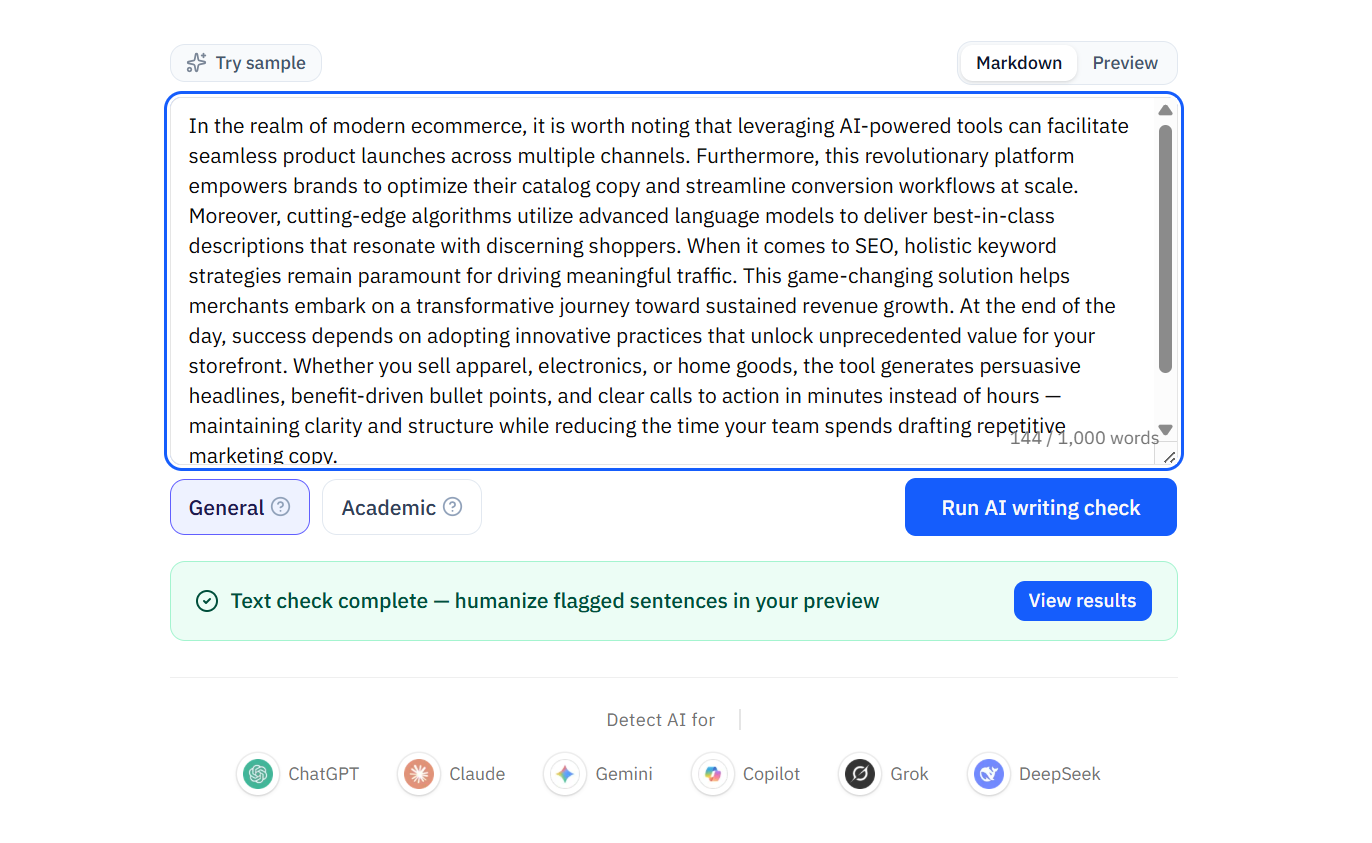
Sentence-level AI detection with pattern-based highlighting and sentence classification
What Are AI Code Detectors?
AI code detectors analyze source code to estimate whether it was written by a human or generated by AI models like ChatGPT, Claude, or GitHub Copilot. Unlike plagiarism checkers (which compare code against known submissions) or prose AI detectors (which analyze natural language), code detectors focus on different signals: token probability patterns, structural features, commenting style, and naming conventions.
The market for AI code detection is growing but remains less mature than prose detection. Popular tools include Copyleaks Code Detector, GPTZero's code detection module, and various open-source GitHub projects. Universities with large CS programs are the primary users, though adoption is far from universal.
- AI code detectors analyze token patterns, not plagiarism — they look for statistical fingerprints of LLM generation, not matches to existing code
- Code detection differs from prose detection — code has stricter syntax, predictable structures, and distinct "natural" patterns
- Detection is harder for code than prose: boilerplate, coding standards, and auto-complete blur the human/AI boundary
- GitHub Copilot complicates detection: AI-assisted code written by a human with Copilot suggestions is neither purely human nor purely AI-generated
How AI Code Detectors Work
AI code detectors rely on three approaches, each with its own strengths and weaknesses.
None of these approaches is reliable enough to serve as standalone evidence. Token probability analysis confuses beginners with AI. Structural analysis confuses clean coders with AI. LLM review confuses good code with AI. In combination, they narrow the uncertainty — but do not eliminate it.
- Token probability analysis: The detector tokenizes the code and evaluates the likelihood of each token sequence given the context. LLM-generated code tends to follow highly probable token paths — the "most likely next token" pattern. Human-written code, especially from experienced developers, often includes unconventional choices: unique variable names, non-standard formatting, creative workarounds. However, beginners following tutorials closely also produce high-probability token sequences, making this signal unreliable for introductory CS courses.
- Structural pattern analysis: The detector examines code structure — function length distribution, nesting depth, abstraction patterns, error handling style. LLMs often generate code with consistent function lengths, uniform nesting, and textbook abstraction patterns. Human code is messier: some functions are too long, error handling is inconsistent, abstractions prioritize readability over purity. But experienced developers following clean code practices also produce structurally "clean" code — this signal is useful for intro courses but less reliable for advanced work.
- Hybrid LLM review: Some detectors use a second LLM to evaluate whether code "looks AI-generated." This is the least reliable approach because LLMs are biased — they often flag well-structured, well-commented code as AI-generated, regardless of its origin. Using AI to detect AI creates a circular evaluation problem that no tool has convincingly solved.
Do AI Code Detectors Actually Work?
The short answer: not reliably enough to base decisions on their output. Independent testing at several universities has found false positive rates ranging from 15% to over 40%, depending on the tool, programming language, and assignment complexity.
The core issue is the lack of a clear boundary between AI-generated and human-written code. Boilerplate code (imports, class declarations, getters/setters) looks identical regardless of origin. Beginner code often mirrors LLM patterns — linear logic, simple data structures, standard library usage. Professional code adhering to team conventions and style guides also looks "clean" in ways that trigger AI detection.
Several high-profile cases have undermined trust in code detectors. In 2024, a Stanford student's original code was flagged as 89% AI by a popular detector — despite being written entirely in a proctored lab. Researchers demonstrated that reformatting AI-generated code (changing variable names, reordering functions, adding comments) dropped detection scores from 95% to below 20% — proving the detector flagged formatting patterns, not AI generation.
When AI Code Detection Actually Matters
For a CS student submitting graded assignments: it matters. Professors may use detectors, and even flawed ones can trigger academic integrity inquiries. Understanding how these tools work — and how to demonstrate your understanding of your code — is practical self-protection.
For a professional developer writing production code: it barely matters. No significant company uses AI code detectors on employee code. Correctness, not origin, is the metric that counts. If the code passes review, tests, and linting, no one cares if ChatGPT helped write it. In fact, AI-assisted coding (via Copilot, Cursor, etc.) is increasingly seen as a baseline expectation in many engineering roles.
For a coding bootcamp graduate building a portfolio: it matters indirectly. Some technical interviewers run portfolio code through detectors as a quick filter. A high AI score doesn’t disqualify you, but it can prompt deeper questions about your process — which you should be prepared to answer regardless.
The contexts where AI code detection matters are those where demonstration of understanding is part of the evaluation. In those contexts, the ability to explain your code verbally is more important than any detector score — because the explanation is the real test.
What CS Students Should Know
If you’re a CS student, here’s what you need to know about AI code detection in academic settings:
First, some professors use these tools — but most care more about whether you understand your code than what a detector says. The classic "gotcha" isn’t a detector score; it’s a follow-up question you can’t answer. If you submit a well-structured solution but can’t explain your algorithm choice, variable naming conventions, or error handling approach, the professor doesn’t need a detector to conclude the work isn’t yours.
Second, AI-generated code has characteristic tells that experienced professors recognize without software: overly verbose comments that describe what the code does rather than why, variable names matching textbook examples exactly, uniform abstraction without pragmatic shortcuts, and solutions using approaches not yet covered in class.
Third, the safest approach is to use AI as a learning accelerator, not a replacement. Ask ChatGPT to explain a concept, then close the tab and write the code yourself. Use Copilot for boilerplate, but write the logic yourself. If you use AI to generate a solution, study it until you can rewrite it from scratch and explain every line — because that’s exactly what a professor might ask you to do.
Code Detection vs. Prose Detection: Why the Difference Matters
AI detection for code is fundamentally harder than for prose, and the reasons reveal why neither type of detection should be treated as authoritative:
- Stricter syntax = less creative surface: Prose has near-infinite stylistic variation; code has one correct syntax. This leaves less room for human idiosyncrasy to distinguish human from AI output — especially in languages with strong conventions like Go or Python.
- Correctness constrains output: A correct bubble sort looks like every other correct bubble sort. The algorithm dictates the expression. Prose has no equivalent constraint — there are countless ways to express the same idea correctly.
- AI assistance is the norm in code: GitHub Copilot had over 1.8 million paying subscribers by 2025. AI-assisted coding is standard practice, not an edge case. The question "was AI involved in writing this code?" is increasingly irrelevant — the real question is "does the developer understand this code?"
- Detection-evasion is trivial for code: Rename variables, reorder functions, restructure conditionals, add comments — and a 95% AI score drops below 20%. Code is more brittle to superficial changes than prose, making detection scores even less reliable.
What to Use Instead of AI Code Detectors
If AI code detectors are unreliable, what should educators, students, and professionals use instead?
For educators: Code explanation interviews remain the gold standard. A 10-minute conversation where a student walks through their solution, explains their design choices, and answers questions about edge cases reveals more about authorship than any automated tool. Some CS departments are shifting toward "process portfolios" — requiring students to submit commit histories and development logs alongside final code.
For students: Prepare to explain your code, not just submit it. If you used AI assistance, be specific about how: "I used ChatGPT to understand recursion better, then wrote this solution myself" is a credible and honest answer. Keep your development history — incremental commits to a private repo are stronger evidence than any detector score.
For professionals: Code review remains the only verification that matters. AI-assisted or not, code that passes review, tests, and meets team standards is good code. Focus on correctness and maintainability, not origin.
Quick Tips
Write the logic yourself, use AI for boilerplate. Write the logic yourself, use AI for boilerplate: Let Copilot handle imports, class scaffolding, and repetitive patterns. Write the core algorithms, data structures, and business logic yourself. This division maximizes AI productivity benefits while ensuring you understand the parts that matter.
Keep a development history. Keep a development history: Incremental commits to a private repo show the evolution of your thinking. A single polished commit that appears fully formed is the code equivalent of a "paste event" in an essay — it suggests generation, not development.
Be ready to explain every line. Be ready to explain every line: If you submit code you can’t explain verbally, the detector score is the least of your problems. The ability to walk through your code and answer "why did you choose this approach?" is the real test.
Do not trust detector scores — in either direction. Don’t trust detector scores — in either direction: A low AI score doesn’t mean your code is safe from scrutiny, and a high score doesn’t mean you’re in trouble. Both numbers measure statistical patterns, not authorship. Focus on understanding, not scores.
Frequently Asked Questions
Common questions about AI code detection.
Q: Can AI code detectors tell if ChatGPT wrote my code?
They can make an educated guess, but not a reliable determination. Current detectors look at token probability patterns, structural consistency, and commenting style — signals that correlate with AI generation but don’t prove it. Beginner programmers following tutorials closely and experienced developers writing clean, well-structured code both trigger these signals. A detector score is a probability estimate, not proof of authorship.
Q: Do universities actually use AI code detectors?
About 60% of CS departments have adopted some form of AI code detection, according to a 2026 ACM survey — but adoption doesn’t mean reliance. Most departments treat detector output as one data point among many, not definitive evidence. The trend is toward process-based assessment (code explanation interviews, development portfolios, incremental submissions) rather than detector-based policing.
Q: What is the difference between AI code detection and plagiarism checking?
Plagiarism checkers (like MOSS or JPlag) compare your code against a database of other students’ submissions and public repositories to find matching structures. AI code detectors analyze the statistical properties of your code in isolation to estimate whether an LLM generated it. They answer different questions: "did you copy this from someone else?" vs. "did an AI write this?" In practice, CS departments often use both — MOSS for plagiarism, plus a newer AI detector — but treat neither as definitive on its own.
Q: Should I worry about AI code detection as a professional developer?
No. AI code detection isn’t used in industry in any meaningful way. Professional code review evaluates correctness, readability, performance, and maintainability — not the origin of each line. AI-assisted coding (Copilot, Cursor, Cody, etc.) is standard practice at most engineering organizations. If your code passes review and tests, nobody cares which lines came from an AI suggestion.
Check your writing — not just your code
If you write technical documentation, README files, or assignment explanations alongside your code, run them through Naturalmelo\
Run AI writing check